ENGR217 Summer 2024 Q B1[VALID]
Answer ALL parts (a) - (d).
A heavy goods lorry uses a 13.4 litre, 4-stroke, 6 cylinder inline diesel engine that generates 412 kW of power at 1700 rpm, with a cut off ratio of 6.3. The overall engine efficiency is 32.5% and the breathing and mechanical efficiencies can be assumed to be 75% and 85% respectively. We will model this engine as the Diesel cycle, operating on an ideal gas and you may assume that and , where is the adiabatic index.
Formulas you may need
- Diesel efficiency: (on the formula sheet)
- Overall efficiency ; power , ; (learn this)
- ; isobaric heat addition ; (on the formula sheet)
- Adiabatic process: ; ideal gas (on the formula sheet)
- Isentropic efficiencies: , (given in the question)
- (a)[10]2:2Determine the thermal efficiency, compression ratio, brake work and net work per cylinder, per cycle.
- (b)[8]FirstGiven that the compression and expansion strokes have isentropic efficiencies of 90% and 85% respectively, determine the actual temperature of each stage of the process, given that at the intake, the air pressure and temperature are and . You may assume that the heat addition per cycle is the same as for the isentropic process. The equations for the isentropic efficiencies are given as: and
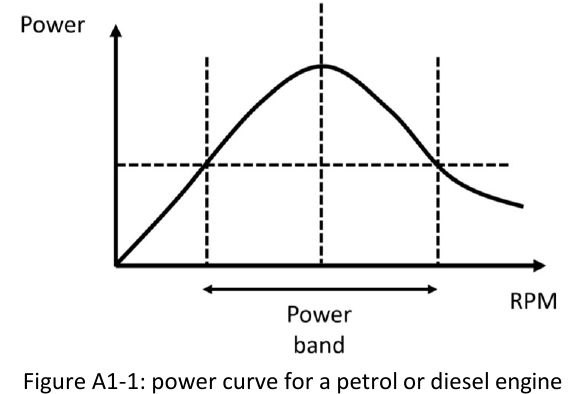
- (c)[5]Without detailed calculations, briefly describe why petrol and diesel engines have a power curve (such as that shown in Figure A1-1). Discuss how the thermal, breathing and mechanical efficiencies vary with RPM, as well as the fuel burn rate of the air/fuel mixture.
- (d)[2]ThirdDiscuss why a diesel engine is preferable for a heavy goods vehicle over petrol engines.