ENGR202 Summer 2017 Q A2[VALID] official answers
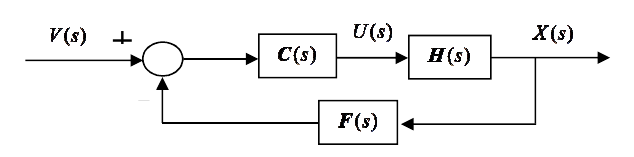
Consider the control system in Figure A2 in which is the plant, is the control algorithm and is a feedback element.
Formulas you may need
- Poles: roots of the characteristic equation; stable if all have negative real parts; dominant = closest to the imaginary axis (learn this)
- Closed loop with feedback element: (learn this)
- Hurwitz for : , need and (given in the question)
- PI controller (learn this)
- (a)[5]What are the name of the signals , and ? Using Figure A2 as an example, explain the difference between open and closed-loop control. Give a practical example of both open and closed-loop control.
- (b)[6]Assume the following Transfer Function for this part of the question: Determine the poles of and sketch their position on the -plane. What is the stability of . Identify the dominant poles and sketch the likely form of the time response mode. Note: this part of the question concerns only.
- (c)[6]Using either standard algebra or the rules of block diagram manipulation, determine the closed-loop Transfer Function for Figure A2 i.e. the relationship between and . Next, an engineer implements a simple proportional control system based on and where is a scalar control gain. In this case, show how for large values of the error approaches zero. What are the disadvantages of this control system?
- (d)[8]Still using Figure A2, now assume the following Transfer Functions: What is the name of this controller? Using these definitions of , and , determine the closed-loop characteristic equation and the associated Hurwitz determinant. Use your answer to find the minimum values of and that ensure stability of the closed-loop system. Note: given then