ENGR202 Summer 2024 Q B1[VALID]
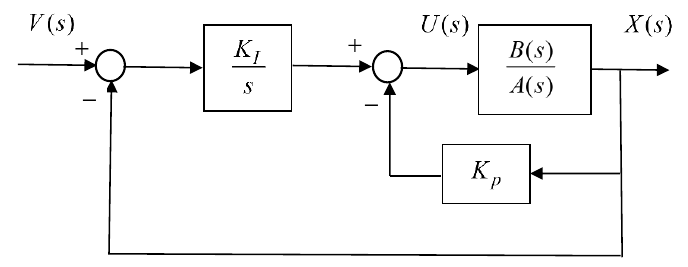
Figure B1-1 consists of some control actions and a model. Using standard terminology, is the output, is the control input and is the set point. Also, and are control gains, whilst and are polynomials representing the model.
Formulas you may need
- Negative feedback rule ; series rule (learn this)
- Steady state gain: set (learn this)
- Pole placement: desired poles give the characteristic polynomial ; match coefficients (learn this)
- ; (learn this)
- (a)[8]Giving your reason, state if Figure B1-1 is an example of open-loop or closed-loop control. What are the advantages and disadvantages open-loop and closed-loop control?
- (b)[8]Develop the Transfer Function for the relationship between and in Figure B1-1. Determine the steady state gain of this Transfer Function and comment on your answer.
- (c)[2]In the case that and , where and are coefficients, determine the pole(s) and zero(s) of the model (without control).
- (d)[3]Using a different model, one that represents a DC motor in a laboratory experiment, an engineer has determined the following Transfer Function for the control system in Figure B1-1. Here, is the motor speed. Design a controller such that that the poles of the characteristic equation are a complex conjugate pair .
- (e)[4]In terms of the response mode and stability, what is the significance of the pole positions stated in part (d) above? When the controller from part (d) is implemented in the lab, the control system starts to yield an unstable oscillatory response to a change in the set point. Speculate as to what might have happened. Hint: even if you were unsure how to answer part (d), you can still attempt this question part.