ENGR216 Summer 2017 Q B2[VALID] official answers
Answer ALL parts (a) - (d).
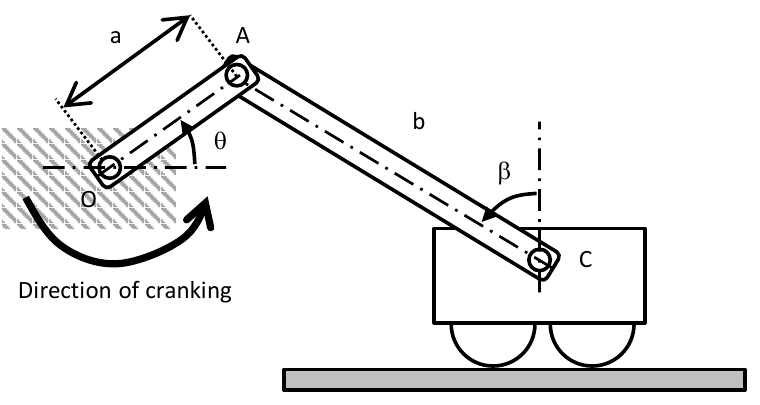
In a food factory, a machine for processing confectionery consists of two rollers mounted on a carriage which moves back and forth over a base plate. Confectionery mixture is placed on the base plate and movement of the carriage rolls the confectionery material out until the desired thickness is achieved. A crank OA and connecting rod AC are used to move the carriage back and forth (Figure B2). The crank is driven by a geared electric motor.
The following particulars are given:
- Crank radius a:
- Connecting rod length b:
- Crank rotation speed (constant):
- Mass of carriage, including rollers, m:
Formulas you may need
- Angular speed conversion (rev/min to rad/s) (learn this)
- Relative velocity (given in the 2017 Section B formula sheet; not on the 2026 sheet, so learn this)
- Relative acceleration (given in the 2017 Section B formula sheet; learn this)
- Instantaneous centre (given in the 2017 Section B formula sheet; learn this)
- Fixed-axis rotation at constant speed: (learn this)
- for the translating carriage; a light pinned rod is a two-force member (given in the 2017 Section B formula sheet / learn this)
- (a)[10]2:2When the crankshaft is in the position shown, angle is and angle is instantaneously. Find the velocity of the carriage when in this position and the angular velocity of link AC.
- (b)[7]Find the acceleration of the carriage for the same position.
- (c)[3]2:2Find the angular acceleration of link AC for the same position.
- (d)[5]When there is no confectionery mixture on the base plate, the carriage rolls with very little friction. For this case, find the force in the connecting rod for the position shown in Figure B2.