Dynamics L5 Worked example 2TutorialOld spec ENGR2162:215 min

ENGR216 Dynamics L5 worked example 2 (slides 13-18) official answers

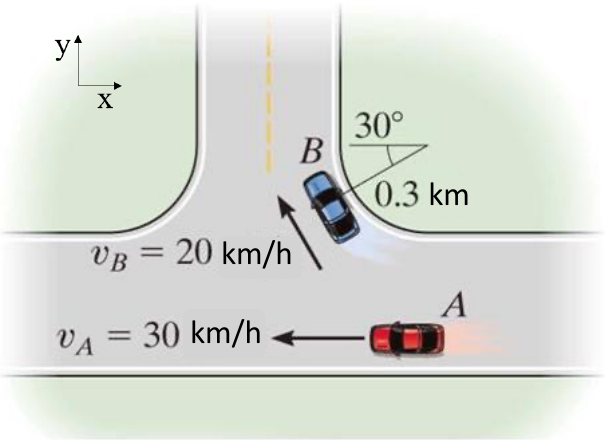
Car A travels west (−x-x) along a straight road at a steady 30 km/h. Car B is turning out of a junction on a curve of radius 0.3 km. At the instant shown, the line from B to the centre of curvature of its path points up and to the right at 30∘30^\circ above the +x+x axis, and B moves along its path (perpendicular to that line, up and to the left) at vB=20v_B = 20 km/h, with its speed increasing at (at)B=1200(a_t)_B = 1200 km/h2^2.

Find the velocity vB/A\mathbf v_{B/A} and acceleration aB/A\mathbf a_{B/A} of car B relative to car A (magnitudes and directions). Axes: xx to the right, yy up the page.

Car A moves left at 30 km/h; car B rounds a corner of radius 0.3 km, moving up and to the left at 20 km/h; the radius line from B to the centre of curvature is at 30 degrees to the horizontal.
Formulas you may need
  • Relative motion (translating axes): vB/A=vB−vA\mathbf v_{B/A} = \mathbf v_B - \mathbf v_A, aB/A=aB−aA\mathbf a_{B/A} = \mathbf a_B - \mathbf a_A (learn this)
  • n-t components: at=v˙a_t = \dot v, an=v2/ρa_n = v^2/\rho towards the centre of curvature (learn this)
  1. (a)
    Find vB/A\mathbf v_{B/A}.
  2. (b)
    Find aB/A\mathbf a_{B/A}.