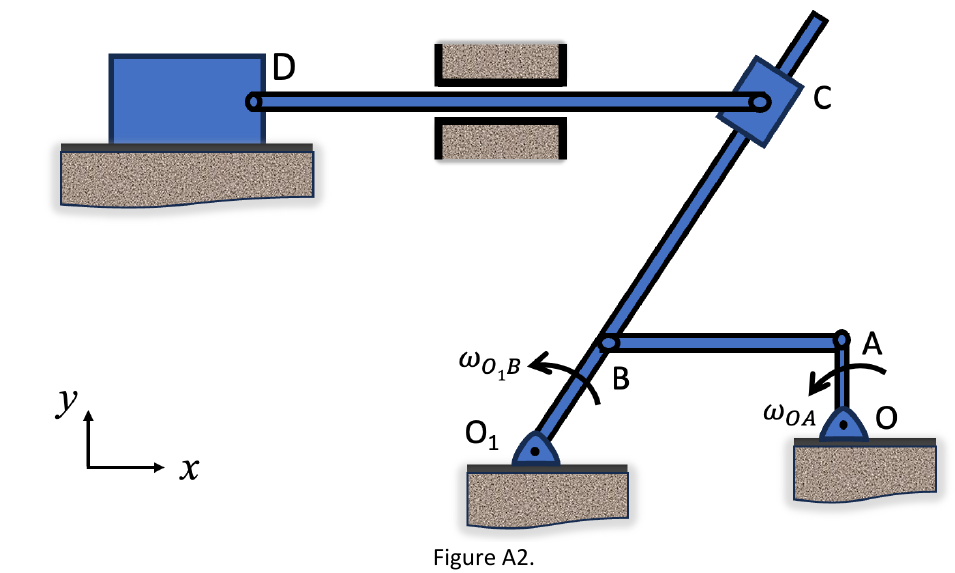
Figure A2 shows a lightweight lever-type steel pushing machine. The crank AB is rotating with
ωOA=0.5 rad/s, connecting the crank AB to make the rod O1B rotate around the axis O1. Rod
DC is connected to slider block C through a hinge, and the slider block C can slide along rod O1B.
OA=r, AB=3r, O1B=32l, r=0.2 m, l=1 m. At this instant,
BC=34l, AB and DC are both horizontal, and the induced angle between CB and the horizontal
line is 60∘. Neglect the tangential acceleration of point A.
Figure A2: crank OA, horizontal link AB, rod O1B pivoted at O1, slider C on O1B pushing horizontal rod DC.Formulas you may need
Rotation about a fixed axis: v=ω×r, a=α×r−ω2r, at=αr, an=ω2r (learn this)
Relative velocity on a rigid body vB=vA+ω×rB/A (learn this)
Relative acceleration on a rigid body aB=aA+α×rB/A−ω2rB/A (learn this)
Point sliding on a rotating body (rotating axes): vC=vC′+vrel, aC=aC′+arel+2ω×vrel (learn this)
Cross products in the plane: k×i=j, k×j=−i (learn this)
(a)
Show that the velocity of point B with respect to A, vBA, is 303j m/s.
[5]2:2
(b)
Determine the tangential acceleration and angular acceleration of point B with respect to O1.