ENGR273 Summer 2026 Q4[VALID] official answers
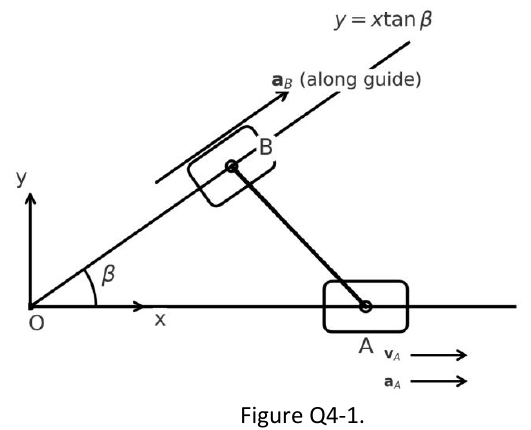
A uniform slender rod AB of mass has its ends constrained to move in two smooth guides (Figure Q4-1).
- End A slides on the horizontal guide .
- End B slides on a straight guide inclined at angle to the axis (guide line passes through the origin), i.e. , .
At the instant shown:
- with known speed and acceleration to the right: , .
- with known acceleration magnitude along the inclined guide as shown in figure Q4-1 (direction , where is the unit tangent of the guide).
A driving actuator applies an unknown force at A along (through the slider at A). Neglect gravity. Positive angular sense is counterclockwise . .
Formulas you may need
- Instantaneous centre of zero velocity: intersection of the perpendiculars to two known velocity directions; (learn this)
- Relative velocity (learn this)
- Relative acceleration (learn this)
- Equations of motion , , or about any point P: (learn this)
- Slender rod (given in the question)
- (a)[8]2:2Draw the free-body diagram and kinetic diagram of rod AB. Indicate guide reactions at A and B, the actuator force , mass centre G, and inertia terms and (with ).
- (b)[10]2:1Determine the instantaneous centre of zero velocity (IC) of rod AB and locate it relative to points A and B. Hence determine the instantaneous angular velocity and the instantaneous velocity of the mass centre G.
- (c)[7]Using planar rigid-body acceleration relations, determine the instantaneous angular acceleration and the acceleration of the mass centre . Hence determine the actuator force and the guide reactions at A and B required at this instant (in terms of the given variables).