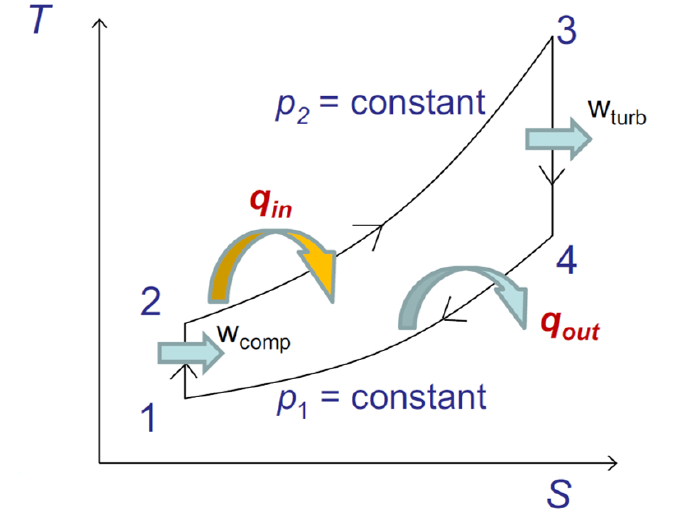
Consider an ideal Brayton cycle (isentropic compression and isentropic expansion). Air may be treated as an ideal gas
with γ=1.4 and cp=1005J/(kgK). The inlet state is T1=300K. The compressor
pressure ratio is rp=8. The maximum (turbine inlet) temperature after combustion is T3=1200K.
States are numbered as in Figure 1.
Figure 1: ideal Brayton cycle on a T-s diagram: 1-2 isentropic compression, 2-3 heat addition at constant p, 3-4 isentropic expansion, 4-1 heat rejection at constant p.Formulas you may need
Adiabatic (isentropic) ideal gas: T1T2=(p1p2)(γ−1)/γ (on the formula sheet)
SFEE with negligible KE and PE: q−w=Δh=cpΔT (on the formula sheet)
Brayton efficiency: ηth=1−T2T1=1−rp−(γ−1)/γ (on the formula sheet)
Thermal efficiency: ηth=qinwnet (on the formula sheet)