ENGR216 Dynamics L17 worked example 1 (slides 11-13) official answers
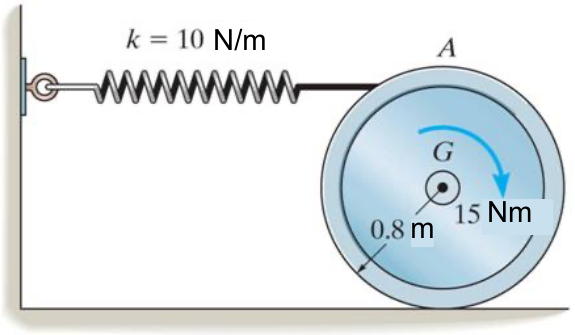
A 40 kg disc of radius 0.8 m and radius of gyration m stands on a horizontal floor. A cord wrapped around its rim leaves the top of the disc (point A) horizontally and is connected to a spring of stiffness N/m anchored to a wall on the left. A constant clockwise couple N m is applied, so the disc rolls to the right, away from the wall, without slipping. It starts from rest with the spring unstretched.
Find the angular velocity of the disc when its centre G has moved 0.5 m.
Formulas you may need
- Principle of work and energy: (learn this)
- Kinetic energy in plane motion: , (learn this)
- Work of a couple ; work of a spring (learn this)
- Rolling without slipping: , (learn this)