ENGR203 Power and Heat 2018 Section B Q B3[VALID]
Answer ALL parts (a) - (c).
Formulas you may need
- Conduction resistance of a flat layer ; convection resistance ; (on the formula sheet)
- Series resistances add: ; parallel resistances: (learn this)
- Steady conduction ; general conduction equation (on the formula sheet)
- Energy: (learn this)
- (a)[6]The temperature distribution in a solid with thermal conductivity can be determined by solving the equation . Describe possible types of boundary condition and combinations thereof that ensure that this equation has a unique solution.
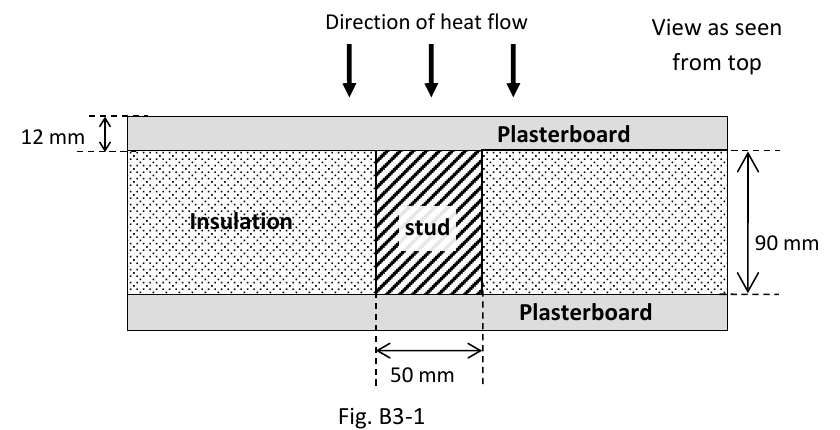
- (b)[10]2:2An interior wall is constructed from vertical wooden studding. Studs are spaced horizontally. The studding is 50 mm wide and 90 mm deep and runs from floor to ceiling. Spaces between the studding are insulated with glass fibre wool. The studding is covered on both sides with 12 mm thick plasterboard. A segment of the wall construction as described above is illustrated by the cross-section drawn in Fig. B3-1. Thermal conductivities are as follows, for the studding , for the plasterboard and for the glass fibre insulation . (i) Calculate the thermal resistance of the wall given that it is 2.4 m high, 5.4 m wide and has 9 full height studs. (8 marks) (ii) If the interior wall separates two thermostatically controlled rooms at temperatures of and , expressing your answer in kWh, how much heat flows through the wall in 24 hours. (2 marks)
- (c)[9]2:2A car rear window is de-misted with a thin film heater on its interior surface. For glass 6 mm thick, determine the power requirement per square metre to maintain an inner surface temperature of when the interior air temperature is , the interior heat transfer coefficient is [sic: read W m K], the exterior air temperature is and the exterior heat transfer coefficient is [sic]. Take the thermal conductivity of the glass as .