ENGR272 Week 6 mock exam Q3 (Dr Andalibi)[VALID] official answers
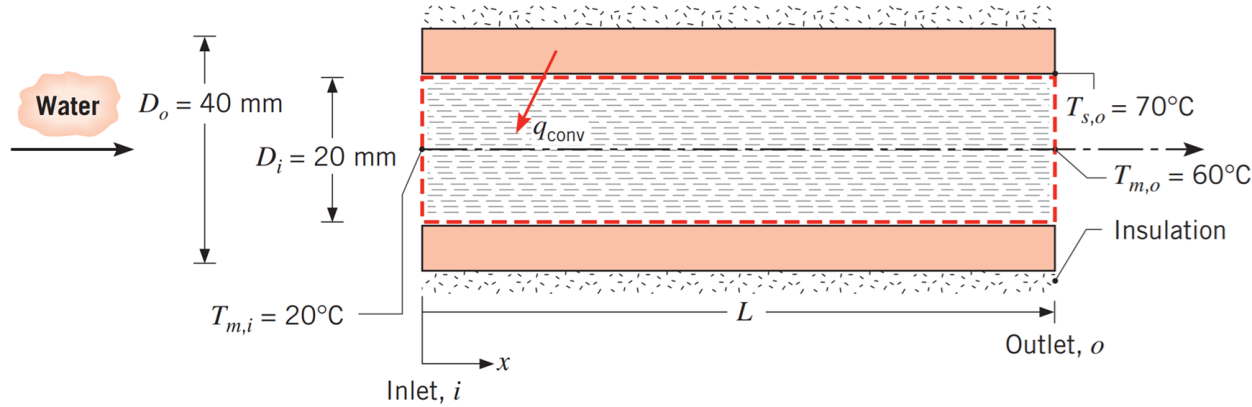
A system for heating water from an inlet temperature of to outlet temperature of involves passing the water through a thick-walled tube having inner and outer diameters of 20 and 40 mm (see schematic below). The outer surface of the tube is well insulated, and electrical heating within the wall provides for a uniform generation rate of .
Formulas you may need
- Energy balance on the flowing water: (on the formula sheet)
- Constant surface heat flux: , (given in the question)
- Newton's law of cooling: (on the formula sheet)
- Heat flux from wall generation (insulated outside): (learn this)
- , so for a circular tube ; laminar below 2300, turbulent above 10 000 (on the formula sheet; the form: learn this)
- (on the formula sheet)
- Sieder-Tate: for , , ; properties at , at (on the formula sheet)
- (a)[5]Write an overall energy balance for the steady state heat exchange between flowing water and the tube walls by considering the entire tube content as the control volume. This equation should relate the change in the heat content of water as a result of convective thermal exchange with the tube wall.
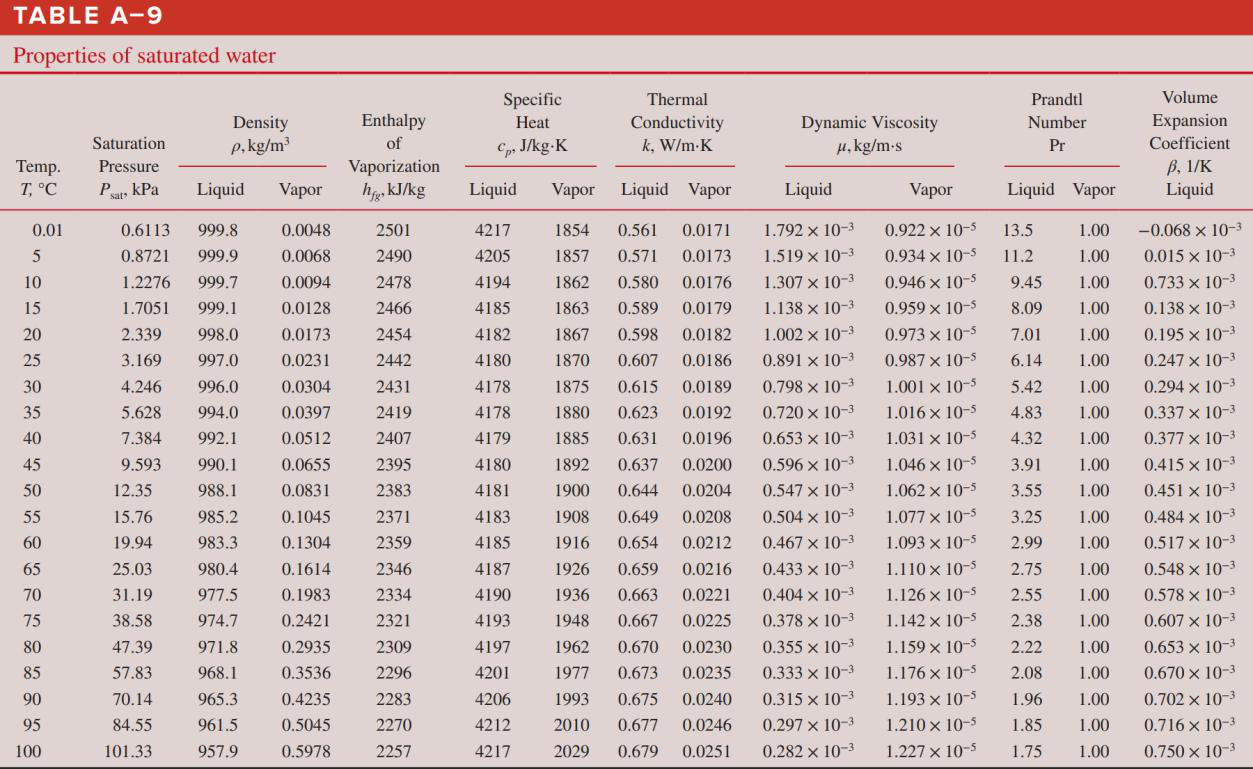
- (b)[10]For the case of constant surface heat flux (), the overall energy balance reads as where is the surface area of inner tube wall. For a water mass flow rate of 0.12 kg/s, how long must the tube be to achieve the desired outlet temperature? Use properties of saturated water at the average of inlet and outlet temperatures (see table below).
- (c)[25]By estimating the local convection heat transfer coefficient, find the inner surface temperature of the tube at the outlet of the pipe. Assume the flow is fully developed at the outlet and that the viscosity of water is almost constant at this cross-section.
- (d)[10]Verify if the assumption in part (c) has a significant impact on the estimated value for the inner wall temperature at the outlet.