ENGR272 Week 6 mock exam Q2 (Dr Andalibi)[VALID] official answers
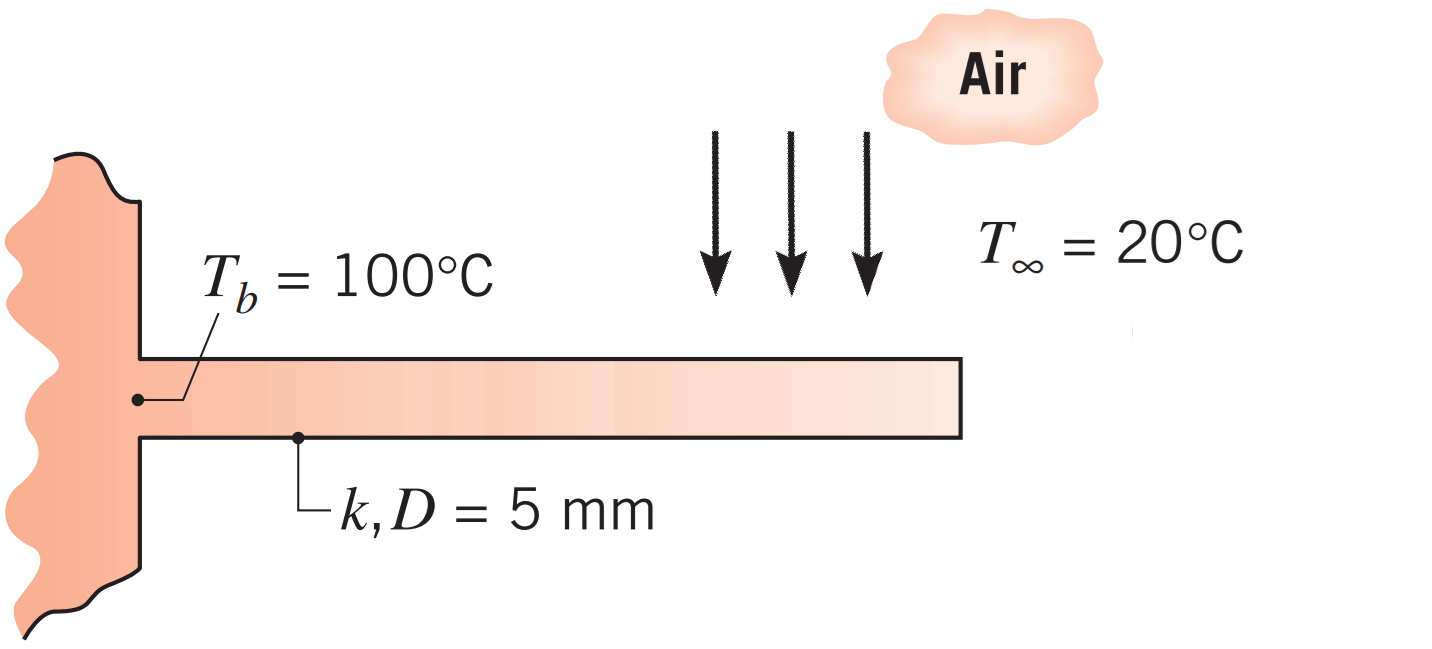
A very long aluminium rod () with a diameter of 5 mm has one end maintained at (the base). The surface of the rod is exposed to ambient air at , flowing at a speed of 5 m/s (see the figure).
Formulas you may need
- Fourier's law (on the formula sheet)
- Newton's law of cooling (on the formula sheet)
- Infinitely long fin: , (on the formula sheet)
- Fin parameter ; for a pin fin , , so (learn this)
- , (on the formula sheet)
- Churchill-Bernstein: for , properties at (on the formula sheet)
- Air properties at 1 atm (Cengel Table A-15) (not given: table needed)
- (a)[10]Assuming steady-state operations, write an energy balance on a differential control volume of the rod and show that the profile of temperature excess () in the form of with satisfies the energy balance. Hint: energy balance for this system can be written as: (Rate of heat conduction into the element at ) = (Rate of heat conduction from the element at ) + (Rate of heat convection from the element).
- (b)[10]Assuming the rod is infinitely long, write the necessary boundary conditions and determine integration constants and , and write the final form of temperature profile equation.
- (c)[5]Knowing the temperature profile equation from part (b), derive an equation for steady state heat transfer rate from the entire rod.
- (d)[15]Assuming the convective heat transfer between the rod and its ambient can be approximated as flow over cylinders, estimate the heat transfer coefficient. To calculate the film temperature, use the average rod temperature (i.e., average of the base and the tip temperatures).
- (e)[10]At what length does the excess temperature at the rod's tip drop to 1% of excess at the base?