ENGR216 Summer 2022 Dynamics Q A2[VALID]
Answer ALL parts (a) - (c).
Formulas you may need
- Rotation about a fixed axis through G: (learn this)
- Angle-dependent integration: , so (learn this)
- ; 1 rev rad, rpm (learn this)
- Newton's second law for a particle: (learn this)
- Rope over a pulley without slip: ; pulley with inertia: , so (learn this)
- Work-energy: , spring work , gravity work (learn this)
- (a)[4]ThirdWhy is a 'moment of inertia' useful when determining the kinetics of a rotating planar rigid body?
- (b(i))[5]A rotating disc driven by a motor has a moment of inertia and begins turning from rest at . The torque applied to the disc by the drive motor is given by where is angular velocity measured in rad/s. What will be the angular velocity in rpm (revolutions per minute) of the disc when it has turned 500 revolutions?
- (b(ii))[3]2:2What is the maximum angular velocity (in rpm) that the disc reaches?
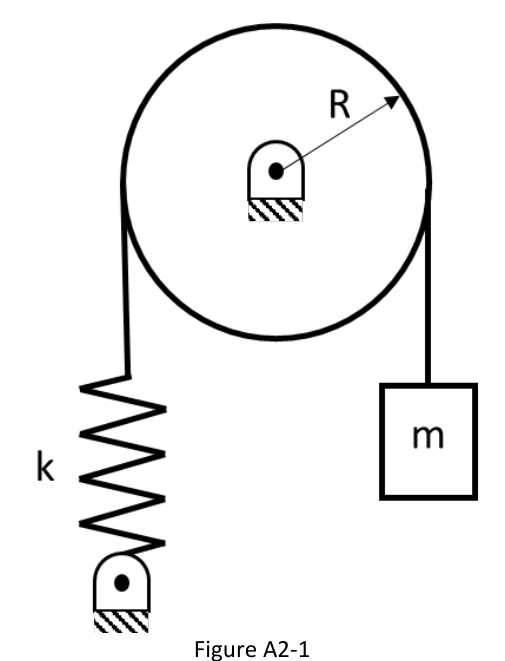
- (c(i))[4]Figure A2-1 shows a pulley-spring-mass system. The pulley has radius mm and moment of inertia and the spring has spring constant N/m. The mass kg. The system is released from rest with the spring in the unstretched position. At the point when the mass has fallen 0.2 m, what is the angular acceleration of the pulley?
- (c(ii))[4]2:2For the condition in (i), what will be the tension in the rope between the mass and the pulley?
- (c(iii))[5]2:2Determine the maximum distance the mass falls before rebounding.