ENGR216 Dynamics L7 worked example 2 (slides 11-13) official answers
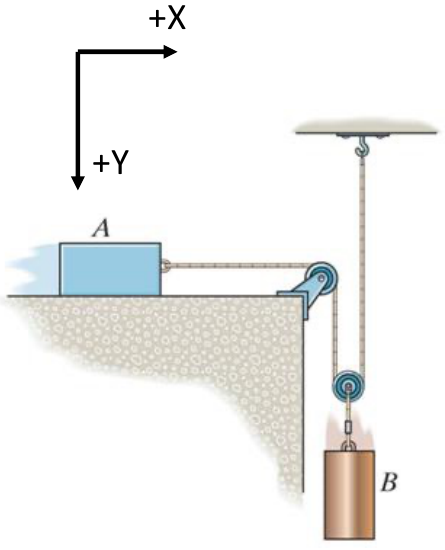
Block A ( kg) rests on a horizontal surface with kinetic friction coefficient . A cord attached to A runs horizontally to a small pulley at the edge of the surface, down to a movable pulley from which cylinder B ( kg) hangs, and back up to a fixed hook on the ceiling (so B is supported by two cord segments). The cord is inextensible and the pulleys are frictionless and massless. At the instant considered, A is moving to the right (towards the edge) at 2 m/s and B is moving down.
Find the speed of A when it has moved 4 m to the right. Take m/s.
Formulas you may need
- Newton's second law: for each body (learn this)
- Kinetic friction: , opposing the sliding (learn this)
- Dependent motion: write the cord length in position coordinates and differentiate (learn this)
- Constant acceleration: (learn this)