ENGR217 Summer 2017 Q B1[VALID]
Answer ALL parts.
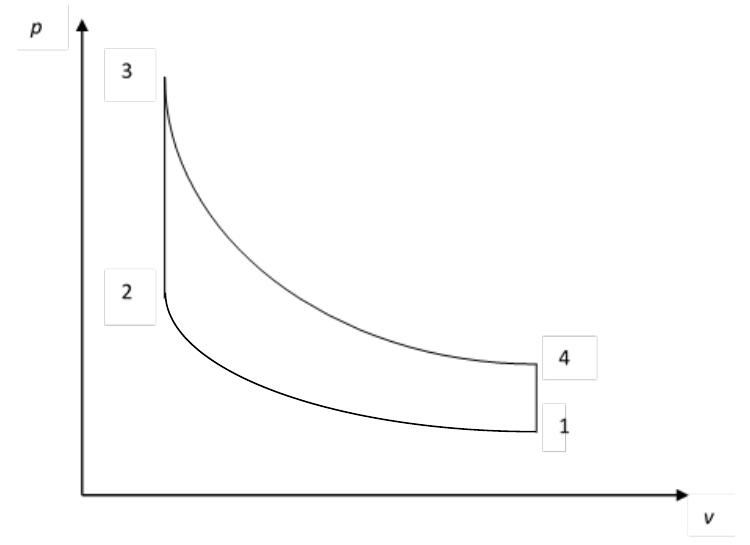
In a certain ideal heat engine, a fixed mass of air is taken repeatedly through the cycle of processes shown in Figure B1 (Pressure Volume (PV) Diagram). Processes 1-2 and 3-4 are adiabatic compression and expansion: work is done, but there is no heat flow in or out. In process 2-3, heat is added, raising the pressure and temperature of the air to and respectively. In process 4-1, heat is removed, to return the air to state 1, the original state.
Formulas you may need
- First law for a cycle: (on the formula sheet)
- Thermal efficiency: (on the formula sheet)
- Adiabatic (isentropic) ideal gas: , so (on the formula sheet)
- Constant-volume heat transfer: (on the formula sheet)
- with for air (on the formula sheet)
- Otto efficiency: (on the formula sheet)
- (a)[8]ThirdIn this heat engine, the mass of air contained in the cylinder is . The heat added per unit mass of air is 1450 kJ/kg, and heat rejected in process 4-1 is 1160 kJ/kg. Find the work delivered per cycle.
- (b(i))[9]The sequence of processes that take place in a spark-ignition engine is represented approximately by the Otto cycle, again illustrated by Figure B1, in which the addition of heat in process 2-3 takes place at constant volume, and similarly the heat rejection in process 4-1. A certain spark-ignition engine has compression ratio . In the engine cycle, air is compressed adiabatically from state 1 (, ) to state 2. Then, in process 2-3, 2500 kJ/kg of heat is added at constant volume, raising the temperature to and the pressure to . The air is then expanded isentropically to state 4, doing work on the pistons as it does so. Finally, heat is removed, to return the air to state 1, the original state. i. Find the temperatures , , and , in . Take , the ratio of specific heats for air, as 1.4.
- (b(ii))[4]ii. Find the amount of heat rejected in process 4-1, per kg of working fluid.
- (b(iii))[2]iii. Hence, or otherwise, find the work output of the engine per cycle.
- (b(iv))[2]iv. Estimate the thermal efficiency of the engine. Indicate whether this efficiency is likely to be achieved in practice, explaining your answer.