ENGR217 Summer 2019 Q B2[VALID] official answers
Answer ALL parts (a) - (e).
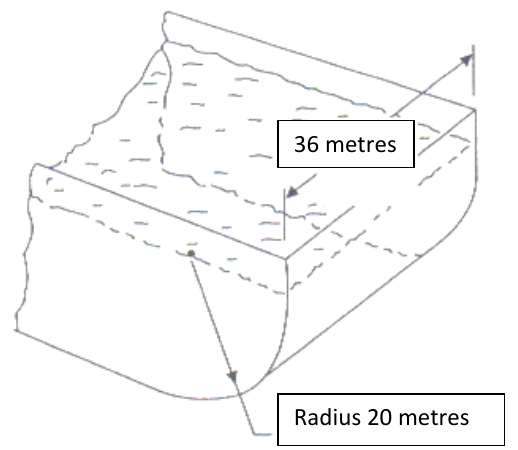
The ends of a water tank shown in Figure B2-1 below, are of radius 20 m and 36 m long, in the form of circular quadrants. We wish to determine the force exerted by the water on one end of the tank. To calculate the force by direct summation or integration is laborious. It is far simpler to choose a suitable volume of liquid (one pressing against the end of the tank and otherwise bounded by planes) and write down the conditions of equilibrium for it.
Take the quadrant-shaped volume of water. The area of the quadrant is . The forces on this water consist of its weight W, the force F acting on the vertical plane which forms the left hand boundary, and the force R exerted by the inner surface of the tank wall.
[Data Book: water .]
Formulas you may need
- Weight: (on the formula sheet, )
- Force on a plane surface: (on the formula sheet)
- Centre of pressure: , rectangle (on the formula sheet)
- Quadrant centroid from a straight edge: (on the formula sheet, semicircle row of the shape table)
- Curved surface by equilibrium of a fluid volume: , (learn this)
- Three non-parallel forces in equilibrium are concurrent (learn this)
- (a)[3]What is the volume of water in the quadrant shaped end of the tank?
- (b)[2]What is the weight W?
- (c)[8]Find the force acting on the left of this volume of water.
- (d)[2]Draw the triangle of forces and indicate magnitudes and direction.
- (e)[10]Find where the force R acts.