Week 1 Exercises, Exercise 2 (Multiple Fluid Hydrostatics)
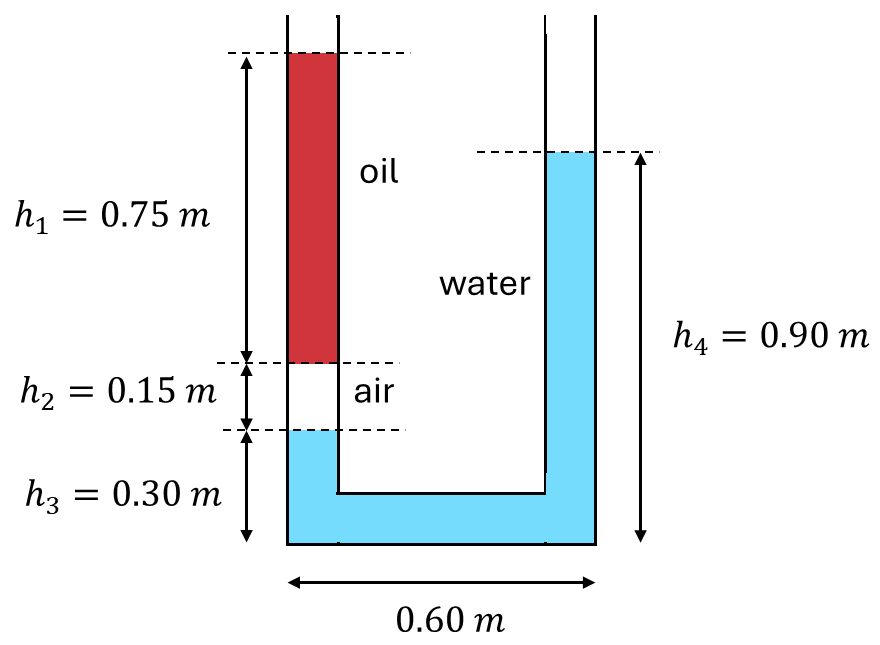
The U-tube shown in the figure contains oil in the left leg, water in both legs, and a trapped air bubble.
The following heights are given:
- Oil column: m
- Air pocket: m
- Water column in the left leg: m
- Water column in the right leg: m
- The horizontal distance between the two legs is 0.60 m.
Using the hydrostatic balance, determine the relative density of the oil.
Data: ; ; .
Formulas you may need
- Pressure at depth: (on the formula sheet)
- Relative density: (on the formula sheet)
- Equal pressure at equal level in one continuous static fluid (learn this; it is the basis of every manometer)