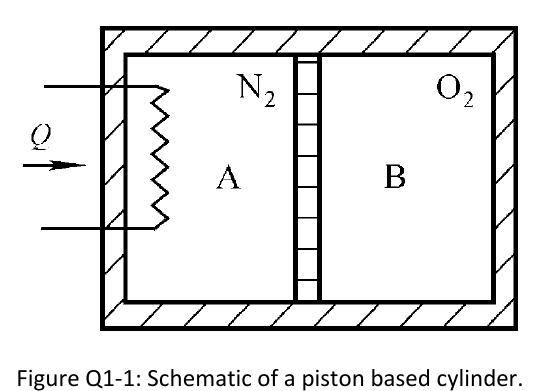
The cylinder-piston system's walls and piston are made of rigid adiabatic material. Side A and Side B
contain N2 and O2, respectively, which have the same temperature, pressure, and volume initially. Given that
TA1=TB1=300K, pA1=pB1=0.1MPa, VA1=VB1=0.5m3.
The piston can move freely without friction within the cylinder. After the electric heater on side A is
powered on, it slowly heats side A until pA2=0.22MPa. Assume that both gases are ideal
gases and calculate using constant specific heats: (see Figure Q1-1).
(MN2=28.0×10⁻³kg/mol, MO2=32.0×10⁻³kg/mol,
R=8.3145J/(mol⋅K), cV,N2=742.1J/(kg⋅K),
cV,O2=649.6J/(kg⋅K), adiabatic index γ=1.4)
Figure Q1-1: Schematic of a piston based cylinder.Formulas you may need
Ideal gas: pV=mRgT with Rg=R/M (and pV=nRT) (on the formula sheet)
Adiabatic (reversible) process: pVγ=const, T1T2=(p1p2)(γ−1)/γ (on the formula sheet)
First law: dU=dQ−dW (heat in +, work out +), dU=mcvdT (on the formula sheet)
Adiabatic work: W=−ΔU; polytropic work magnitude n−1p2V2−p1V1 with n=γ (on the formula sheet)
Free frictionless piston: equal pressures on both sides at every instant (learn this)