ENGR217/266 Summer 2022 Q A2[VALID]
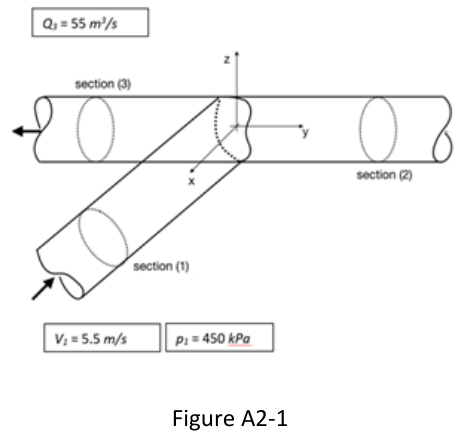
Water flows through a horizontal tee pipe junction as shown in Figure A2-1. The pipe containing section (1) is orthogonal to the pipe joining sections (2) and (3). Each of the three pipes joining the junction has an internal diameter of 2.5 m. The water density can be assumed to be . The flow rate through section (3) is , the average velocity at section (1) is where the pressure is .
Formulas you may need
- Flow rate: , (on the formula sheet)
- Mass balance: , (on the formula sheet)
- Bernoulli (no losses, ): (on the formula sheet)
- (a)[6]Determine the water volume flow rate at section (1) and the average velocity at section (3).
- (b)[5]Use a mass balance to find the water volume flow rate at section (2) and the corresponding average velocity .
- (c)[4]Is the flow directed towards the positive or the negative y direction at (2)?
- (d)[4]State the hypotheses that should be verified by the fluid flow for the Bernoulli's equation to be applicable.
- (e)[6]Assuming that the hypotheses behind Bernoulli's equation are verified by the flow in the junction (see question A2-(d)), consider two streamlines joining respectively section (1) with sections (2) and (3) to determine the pressure at (2) and at (3).