ENGR271 Summer 2026 Q2[VALID]
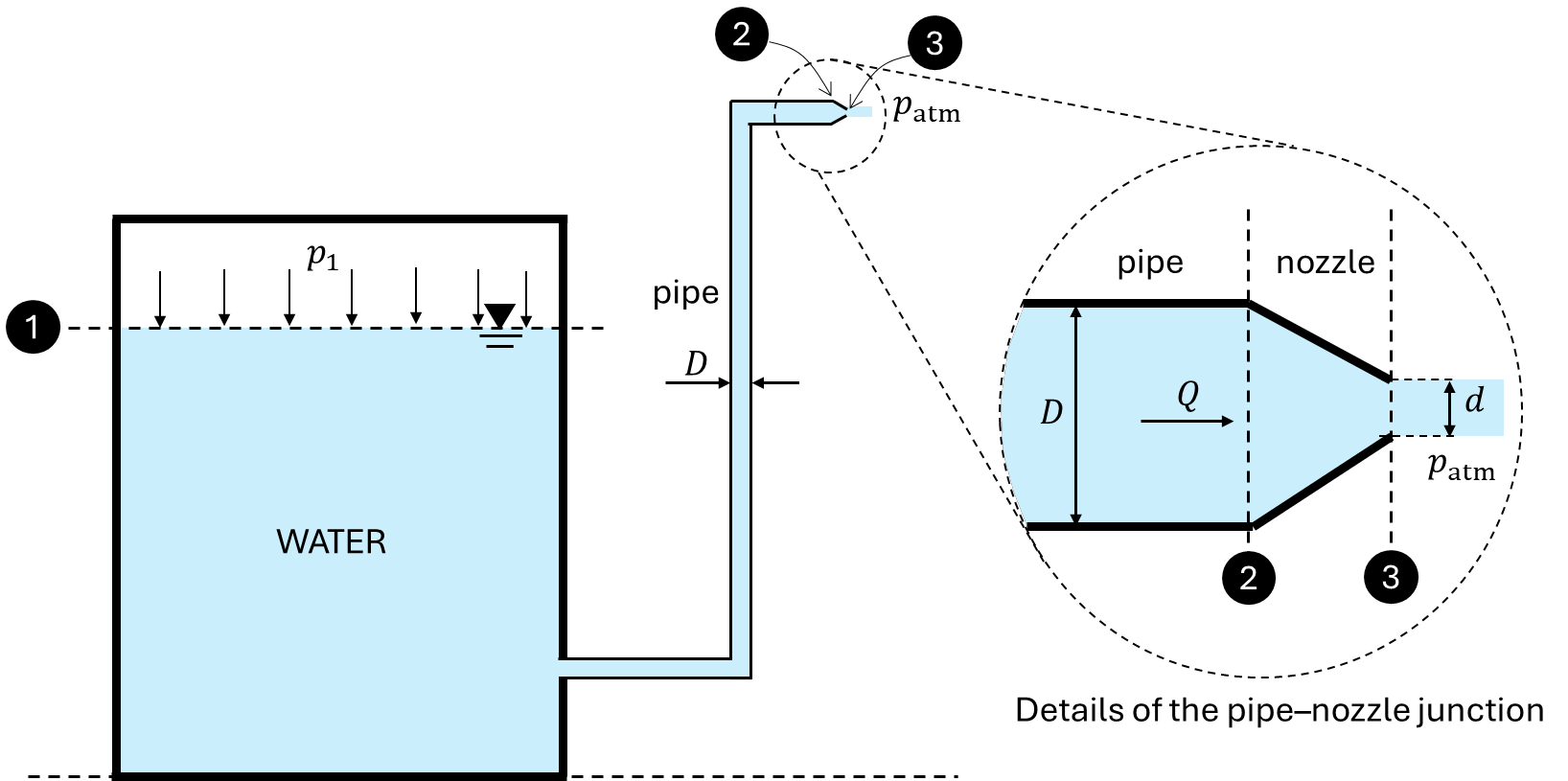
Water flows from a pressurised tank through a pipe and a converging nozzle before discharging to the atmosphere. The tank free surface (section 1) is at elevation m. The pipe rises to the nozzle, and both section 2 (pipe-nozzle junction) and section 3 (nozzle exit) are at the same elevation m (Figure Q2-1 in the paper).
Pipe: length m, diameter m, Darcy friction factor , area . Nozzle: exit diameter m, head-loss coefficient , exit area . Volumetric flow rate . Water: , Pa s. .
Formulas you may need
- Volume flow rate: ; mass flow rate (on the formula sheet)
- Reynolds number: ; pipe laminar , turbulent (on the formula sheet)
- Entrance length: laminar ; turbulent (on the formula sheet)
- Darcy head loss: (on the formula sheet)
- Minor loss: (on the formula sheet; also printed in part (d))
- Hagen-Poiseuille: (laminar only) (on the formula sheet)
- Bernoulli with head loss: (on the formula sheet)
- Momentum balance: , with (on the formula sheet)
- (a)[5]Calculate the average velocity in section 3 (nozzle exit).
- (b)[5]Calculate the flow rate and the fluid velocity in section 2.
- (c)[5]Calculate the Reynolds number in the pipe (excluding the nozzle). Is the flow laminar or turbulent? Using your engineering judgment, explain if considering the flow "fully developed" is a good approximation in this case.
- (d)[5]Calculate the head loss in the nozzle using .
- (e)[5]Calculate the head loss in the pipe. Then discuss and demonstrate whether the Hagen-Poiseuille law can be used to calculate the head loss in this specific case.
- (f)[5]Determine the gauge pressure required at the tank's free surface to sustain the given flow rate. Then comment on which component of the system (the pipe or the nozzle) contributes most to the total energy loss.
- (g)[10]Draw the free-body diagram of the forces around the nozzle (include only the pressure forces at sections 2 and 3 and the force exerted by the nozzle walls on the fluid; neglect gravity and other body forces). Apply the momentum balance equation and determine the force required to restrain the nozzle.