ENGR217/266 Summer 2023 Q A2[VALID] official answers
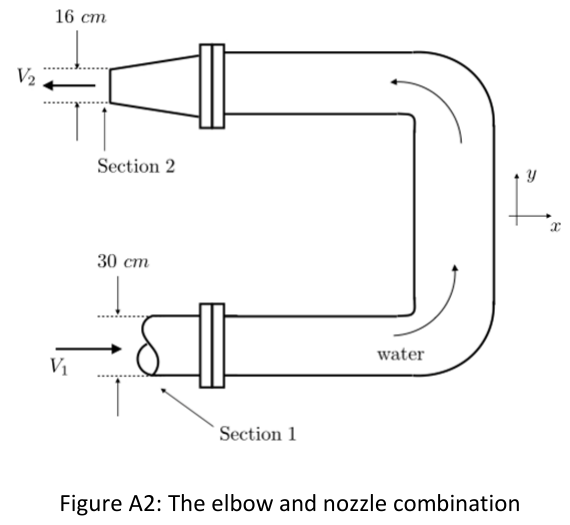
Water circulates through the horizontal elbow shown in Figure A2 with a constant mass flow rate of . The water reaching section 2 (the nozzle exit) is discharged at atmospheric pressure. Taking the water density to be :
Formulas you may need
- Mass flow rate: , (on the formula sheet)
- Bernoulli (no losses, here ): (on the formula sheet)
- Steady-flow momentum balance (vector, per direction): (on the formula sheet)
- Gauge pressure: (on the formula sheet)
- (a)[4]ThirdUse the mass conservation principle to obtain the mean normal velocities at section 1 and 2 (the nozzle outlet).
- (b)[4]ThirdBy neglecting viscous losses, write down Bernoulli's equation between section 1 and section 2.
- (c)[4]2:2Use the above derived Bernoulli's equation to determine the pressure at section 1.
- (d)[6]2:2Explain why the y component of the force required to hold the elbow in place is zero.
- (e)[7]Select an appropriate control volume and apply the momentum equation in the x direction to determine the x component of the force required to hold the elbow.