ENGR271 Summer 2026 Q1[VALID]
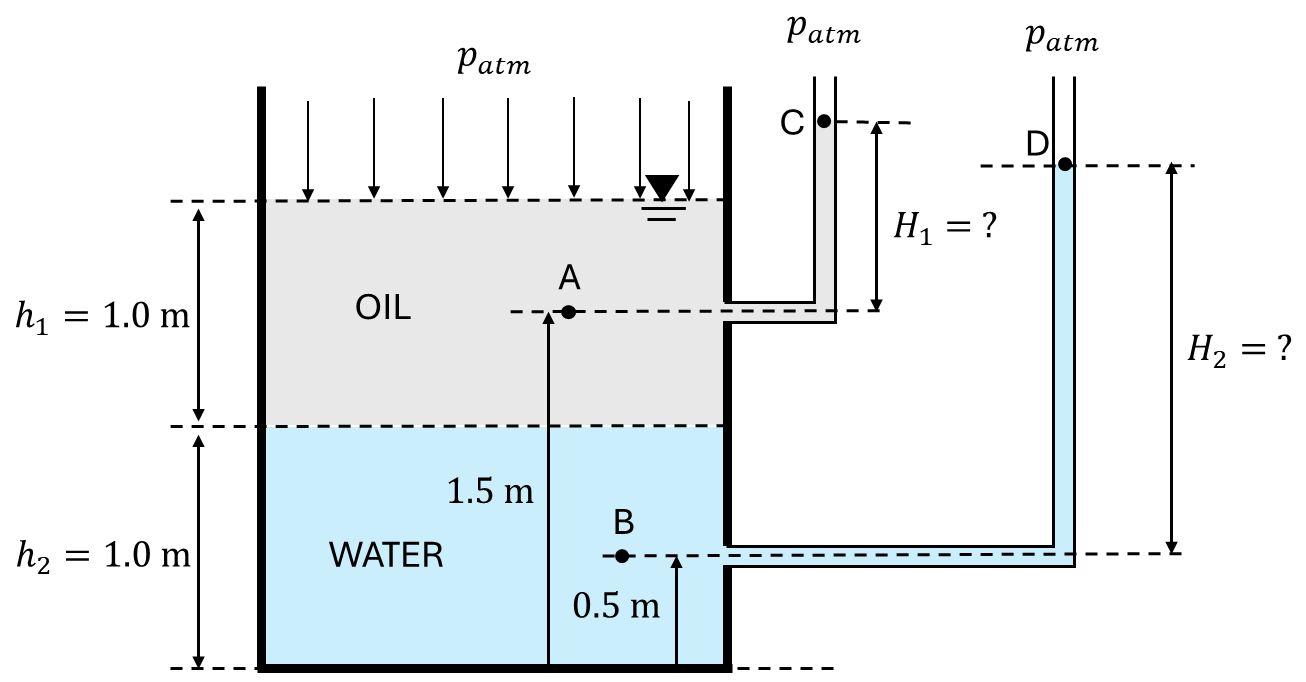
An open vertical tank contains two immiscible liquids: an oil floating on a water layer. The tank bottom is taken as the elevation m. The water layer is 1.0 m deep (density of water ). Above the water there is a layer of oil of 1.0 m depth. The relative density of the oil with respect to water is . The tank is open to the atmosphere, so the free surface is at atmospheric pressure. Take the atmospheric pressure as Pa and .
Two vertical, transparent tubes (piezometers) are connected to the tank, as shown in Fig. Q1-1 (see the paper). One piezometer is connected to the tank wall at an elevation of m above the bottom, and the other at an elevation of m.
Formulas you may need
- Relative density: (on the formula sheet)
- Pressure at depth: ( = depth below the free surface) (on the formula sheet)
- Gauge pressure: (on the formula sheet)
- Pressure continuous across a static fluid-fluid interface; layer by layer (learn this)
- Piezometer: open column of height above the tapping, (learn this; it is the pressure-at-depth formula read backwards)
- (a)[10]Calculate the absolute pressure and the gauge pressure at point A.
- (b)[5]Under hydrostatic conditions, what condition must hold for the pressure at the interface between the two immiscible fluids (oil and water)?
- (c)[5]Determine the elevation reached by the liquid surface in point C. Consider that there is only oil in the tube. The figure is not to scale and piezometer levels are not indicative. Determine and justify your calculation using hydrostatic principles.
- (d)[10]Determine the elevation reached by the liquid surface in point D. Consider that there is only water in the tube. Determine and justify your calculation using hydrostatic principles.