Week 1 Exercises, Exercise 5 (Floating Aluminium Cube)
A cube of aluminium of side m floats in oil as shown in the figure. The relative density of aluminium is , and the relative density of oil is .
Data: ; ; .
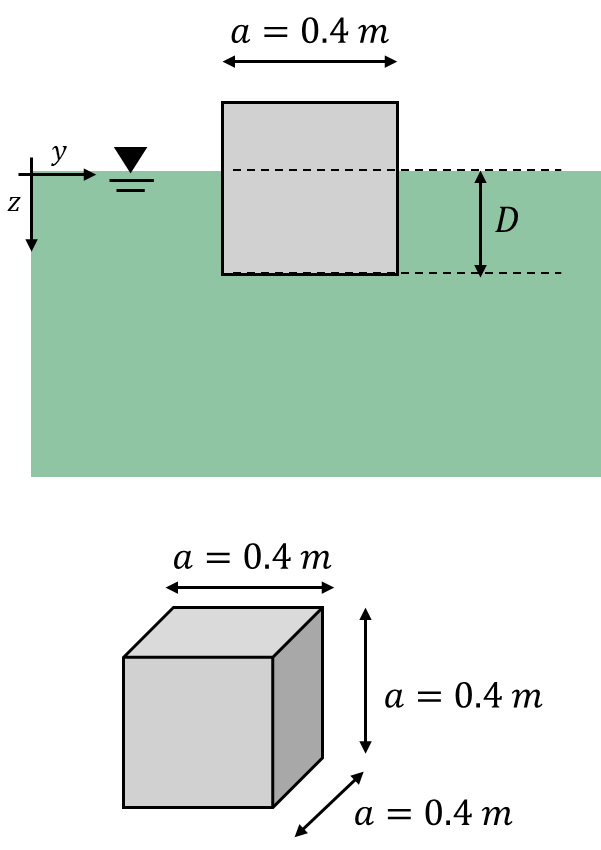
Formulas you may need
- Buoyancy force: (here of the oil) (on the formula sheet)
- Gravity force: (on the formula sheet)
- Relative density: (on the formula sheet)
- Floating equilibrium: , so for a uniform prism (learn this)
- (a)Determine whether the cube will float or sink.
- (b)If it floats, calculate the submerged depth .
- (c)What happens in the case of a cube of wood of the same dimension ()?