ENGR216 Summer 2017 Q A2[VALID] official answers
Answer ALL parts (a) - (e)
Section A Appendix (as printed with the paper):
The differential relationship between shear load and distributed load acting on a beam is:
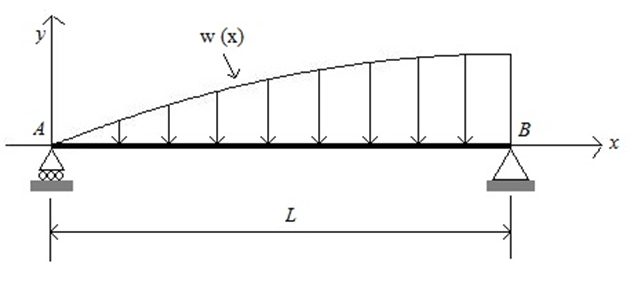
Consider the statically determinate beam with flexural rigidity and length depicted in Figure A2, subject to the distributed load , where denotes the coordinate along the horizontal axis depicted in the figure with origin at end A of the beam.
Formulas you may need
- Elastic curve (given in the question; learn this; on the 2025 sheet but not the 2026 one)
- (given in the question; also on the formula sheet); and the positive shear / positive bending sign convention (on the formula sheet)
- Resultant of a distributed load and its position (on the formula sheet)
- Equilibrium , , ; a roller gives one reaction normal to its surface, a pin gives two (learn this)
- Boundary conditions at simple supports: ; slope (rotation of the section, small angles) (learn this)
- (a)[3]2:2Knowing that the bending moment is positive over the entire beam, and noting that the relationship between and the local deflection is: where the y axis is depicted in Figure A2 and has origin at end A of the beam, sketch the deformed shape of the beam mean line. For your sketch, use the same Cartesian (xy) axes system as defined in Figure A2.
- (b)[5]2:2Sketch the free body diagram of the loaded beam and determine the magnitude and orientation of the reactions acting on its two ends if the distributed load is given by: where is a constant distributed load.
- (c)[5]2:2Using the differential relationship between shear load and distributed load provided in the Appendix, demonstrate that, for the considered problem, the shear load along the beam is:
- (d)[6]2:2Knowing that the equation of the deformed mean line of the beam is: determine the constants and by imposing the compatibility condition of the beam deformation expressed by Equation (4) with the constraints acting on the beam depicted in Figure A2.
- (e)[6]Determine the rotation (magnitude and direction) of the beam sections at ends A and B as functions of , and .