ENGR216 Summer 2017 Q B3[VALID] official answers
Answer ALL parts (a) - (d)
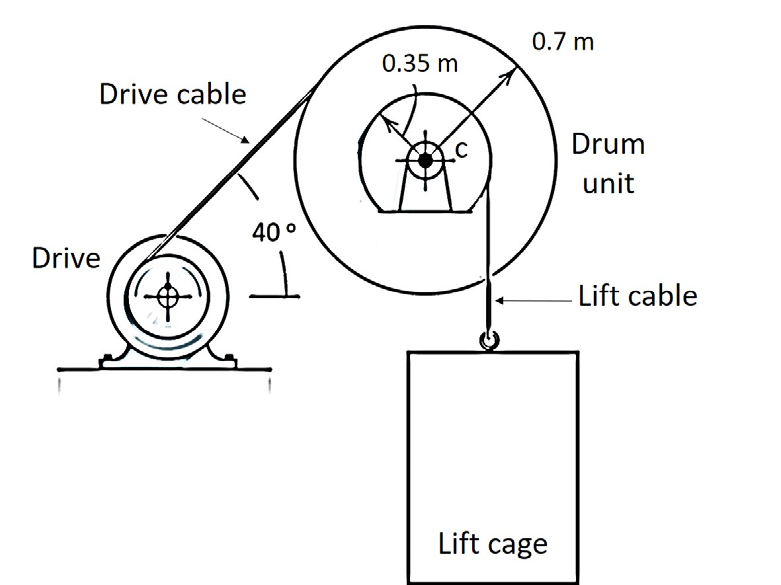
Figure B3 shows a load lifting mechanism. The lift cage is raised and lowered by rotation of the drum unit which is cable driven via the electric drive unit. The lift load capacity is 350 kg, the drum unit has a mass of 95 kg and the radius of gyration of the drum unit about its mounting at C is 0.4 m. When raising the lift cage, the drive unit produces a constant tension in the cable of 2000 N and the cable contacts the drum without slipping.
Formulas you may need
- Moment of inertia and radius of gyration , so (given in the 2017 Section B formula sheet; not on the 2026 sheet, so learn this)
- Fixed-axis rotation (given in the 2017 Section B formula sheet; learn this)
- (given in the 2017 Section B formula sheet; learn this)
- No-slip cable on a drum: (tangential acceleration of the drum surface equals the cable acceleration) (learn this)
- (a)[5]ThirdExplain what is meant by a moment of inertia of a solid.
- (b)[8]Draw free body and kinetic diagrams for the cage and the drum unit, and from these derive equations of motion for the drum unit and the lift cage for the case when the lift cage is being raised by the drive unit.
- (c)[6]For the case when the lift is loaded to full capacity and being raised, calculate the tension in the lift cable, the acceleration of the lift cage and the angular acceleration of the drum unit.
- (d)[6]For the case when the lift cage is loaded to full capacity and being raised, calculate the force in the bearing at C and its direction of action.