ENGR216 Summer 2019 Q B3[VALID]
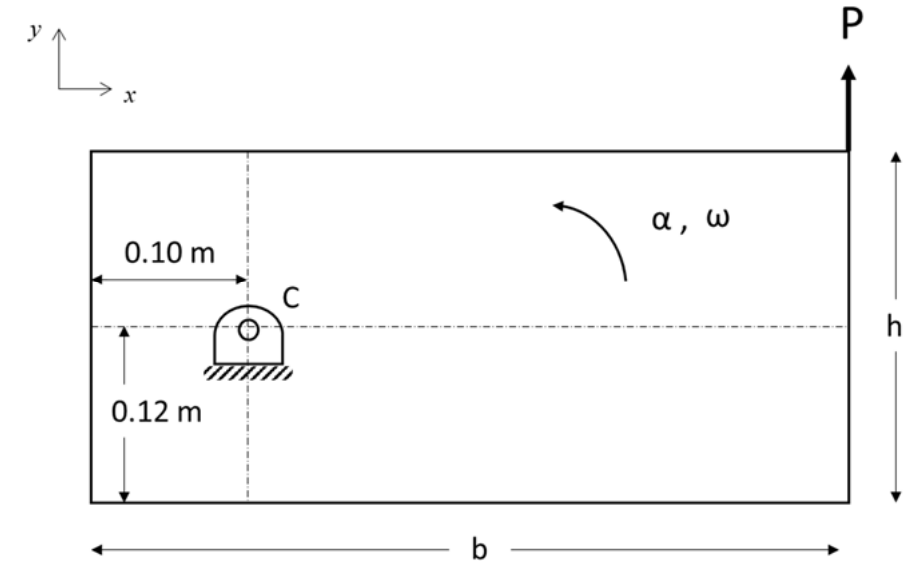
The uniform steel plate shown in Figure B3 rotates about point C in the - plane due to the combined effects of gravity and the vertical force, P. At the instant shown in Figure B3, the plate has an angular velocity, rad/s and an angular acceleration, both in the counter-clockwise direction. The plate has a mass of kg, and dimensions m and m.
Formulas you may need
- Plate about its centroid: (given in the question)
- Moment of inertia definition and radius of gyration (given in the 2019 Section B appendix; learn this)
- Parallel-axis theorem: (learn this)
- Fixed-axis rotation of G: (towards C), (learn this)
- Equations of motion: , (or ) (given in the 2019 Section B appendix; not on the 2026 sheet, so learn this)
- (a)[4]ThirdFor the plate shown in Figure B3, the moment of inertia for rotation in the - plane about an axis located at the centroid is given by Explain what a moment of inertia is, and calculate for the plate.
- (b)[6]In your answer book, sketch a free body diagram of the plate showing the location and direction of external forces acting on the plate, and sketch the corresponding kinetic diagram showing the couple moments that are produced by the dynamic forces.
- (c)[6]Calculate the normal and transverse components of acceleration acting on the plate's centre of mass (centroid).
- (d)[4]Determine the magnitude of force P.
- (e)[5]Determine the reactions in the x direction, and the y direction, that are produced at point C.