ENGR216 Summer 2023 Dynamics Q B1[PARTIAL] Left out: Part (b) (estimating the boom mass from a photograph and its effect on safe working load) is open-ended engineering judgement, not covered in ENGR5004.
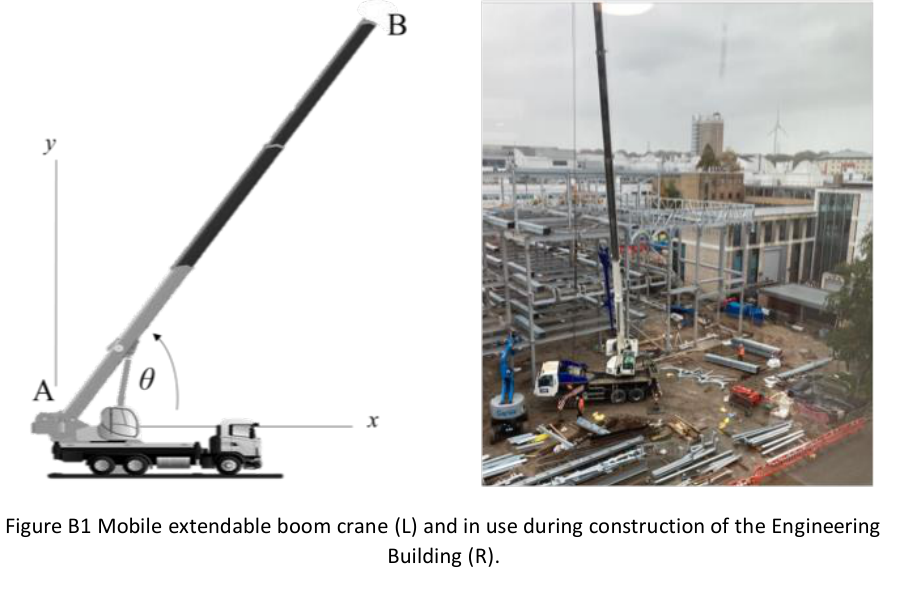
Figure B1 shows an extendable boom mobile crane, typical of the type that was used to construct the new Engineering Building. Before the boom is retracted, distance AB = 25 m and . To retract the boom, Point B is moved toward Point A with a constant radial acceleration of and is lowered toward the vehicle deck with a constant angular acceleration of . At the time seconds after the boom begins to retract, determine:
Formulas you may need
- Constant acceleration: , (and the same for ) (learn this)
- Polar velocity: (learn this)
- Polar acceleration: (learn this)
- Normal-tangential components: , , (learn this)
- (a(i))[5]2:2The velocity of Point B
- (a(ii))[5]2:2The acceleration of Point B
- (a(iii))[5]The radius of curvature of the path that B follows.
- (b(i))[5]Using the photograph of the crane on site shown in Figure B1, estimate the mass of the boom if length AB = 60 m when fully extended. The boom is manufactured from hollow box section steel. State any assumptions that you make.
- (b(ii))[5]How would the mass of the boom influence the designed safe working load of the crane?