ENGR216 Summer 2025 Q B1[VALID] official answers
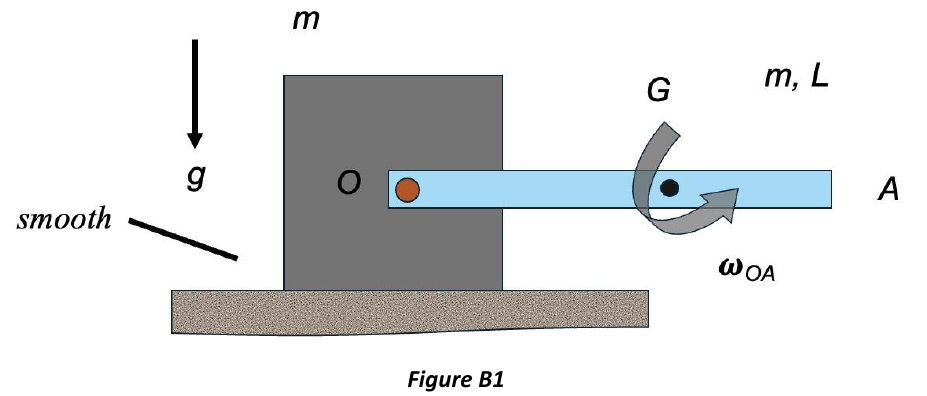
A uniform rod OA with a mass () and length () is centrally affixed to a uniform block of mass (). 'O' is the centre of rotation for the rod OA, which is also the centroid of the block, as shown in Figure B1. The block is positioned to move freely along a smooth horizontal surface. Initially, the system is at rest, and the rod OA is oriented horizontally with an initial counterclockwise angular velocity .
Formulas you may need
- Relative acceleration (rigid body): (learn this)
- Equations of motion: , ; for a translating body (learn this)
- Slender rod about its centre: (learn this)
- Moments about another point P (check): (learn this)
- Newton's third law at a pin: equal and opposite pin forces on the two bodies (learn this)
- Friction: static , kinetic , opposing the (impending) relative sliding (learn this)
- (a)[10]Draw the free-body and kinetic diagrams of the rod OA and the block. State appropriate coordinate systems.
- (b)[5]Determine the acceleration of point O on the initial instant.
- (c)[5]2:2Determine the angular acceleration of the rod OA at the instant of (b).
- (d)[5]If there is friction between the block and the horizontal surface, will the acceleration of point O increase or decrease? Give your reasoning.