ENGR216 Statics Progress Test 2024, Question 1 (solved in Statics session 21)[VALID] official answers
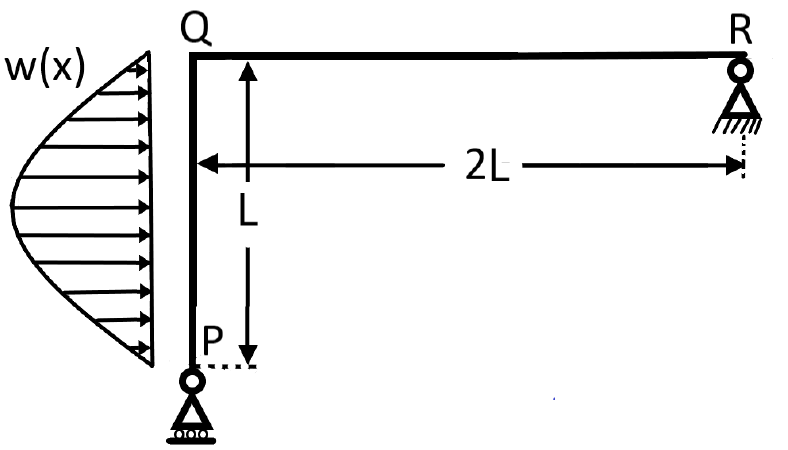
Consider the structure of Figure 1: a vertical member PQ of length rigidly joined at Q to a horizontal member QR of length . P rests on a roller support (vertical reaction only) and R is pinned. Member PQ is loaded by the harmonic distributed normal load
acting horizontally to the right, with position measured along PQ with origin at P, and in N/m.
Formulas you may need
- Resultant of a distributed load and its position (on the formula sheet)
- , , , (on the formula sheet)
- Positive shear and positive bending sign convention (pictures) (on the formula sheet)
- Combined axial force and bending (eccentric loading form) (on the formula sheet)
- Solid circle (on the formula sheet)
- (learn this; integration by parts)
- Static equilibrium , , ; roller gives one force, pin gives two (learn this)
- (a)2:2Draw the free-body diagram of the entire structure, indicating all nonzero reactions.
- (b)2:2Determine all reactions acting on the structure as functions of and .
- (c)Calculate the axial load distribution , the shearing load distribution and the bending moment distribution along members PQ and QR.
- (d)2:2Draw the , and diagrams along members PQ and QR.
- (e)2:2Draw the free-body diagram of the vertical member PQ, indicating clearly all nonzero external and internal loads, and give the expressions of all internal and external loads acting on it as functions of and .
- (f)Calculate the magnitude of the maximum compressive stress, in kPa, in the cross section of member PQ at from end P. Assume a circular cross section of radius mm, and use m and kN/m.