ENGR266 Summer 2019 Q A1[PARTIAL] Left out: Part (c) (9 marks: molar volume of hexane from the ideal gas law and the Pitzer generalised correlation for the second virial coefficient) is left out: the generalised (Pitzer) correlation is not in the current slides or formula sheets (CHECK in the audit).
Answer ALL parts (a) - (d)
Formulas you may need
- Wet-mixture properties: , , (on the formula sheet)
- Ideal gas law: (on the formula sheet)
- Phase rule (triple point: , gives ): (on the formula sheet)
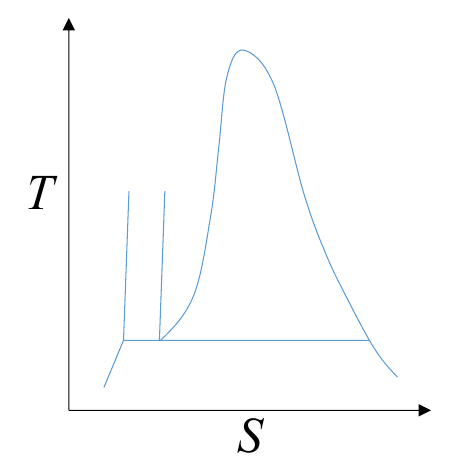
- (a)[8]Sketch the temperature-entropy diagram below and label the solid, solid-liquid, solid-vapour, liquid, liquid-vapour and vapour regions. Also indicate the location of the critical point and the triple-point line.
- (b)[6]Use the data-table provided in Appendix 1 - Thermodynamics for Chemical Engineering: Formula Sheet to calculate the entropy of 1,1,1,2-tetrafluroethane (HFC-134a) at with a volume of .
- (d)[2]ThirdWhat are the two key approximations made in the ideal gas law?