ENGR270 Summer 2026 Q2[VALID]
A wastewater treatment plant removes contaminants and pollutants so that the effluent (treated water) can be safely discharged into a river. An activated sludge process uses aerated microorganisms to biologically break down organic matter and remove nitrogen. The control of dissolved oxygen (DO) is an important factor in the energy costs and overall performance of the plant. The DO is continuously monitored using an electrochemical sensor.
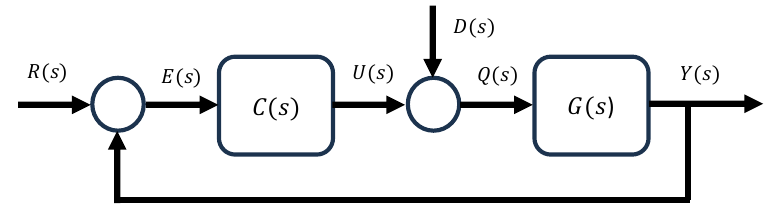
A block diagram for the control of DO is shown in Figure Q2-1, in which and are Transfer Functions representing the control algorithm and the plant model, respectively, i.e. and . The output variable is the DO and represents the control input signal to an aeration rate actuator.
However, there is a fault in the airflow system, such that the aeration rate is affected by an unknown disturbance signal , i.e. . The fault may have arisen from poor maintenance or malicious intent.
The set point represents how much oxygen is required in the activated sludge tank to treat the incoming wastewater effectively. Finally, .
Formulas you may need
- First order : unit step response , 63.2% at (learn this)
- Time delay : the same response shifted right by (Transfer Function factor ) (learn this)
- Unity feedback: (learn this)
- Final value theorem: ; a constant has transform (learn this)
- Integral action ; PID (learn this)
- (a)[8]Explain why Figure Q2-1 is called unity feedback closed-loop control. Speculate on how an open-loop controller could be designed for this plant. What are the advantages of closed-loop compared to open-loop control in this context?
- (b(i))[7]For this question part only, i.e. (b) (i), (b) (ii) and (b) (iii), assume and the plant model . For zero initial conditions, sketch the response of the plant model to a unit step, i.e. for . Use your sketch to define and explain the terms steady state gain and time constant. Add to your sketch the unit step response of a model with the same time constant and steady state gain, but which has a time delay of 10 s.
- (b(ii))[5]For where is the control gain, determine the closed-loop Transfer Function, i.e. the relationship between and . Design a controller to ensure the closed-loop time constant is 10 s.
- (b(iii))[3]Briefly explain the advantages of using PID control, in comparison to the simple controller from (b) (ii).
- (c)[5]Develop the closed loop Transfer Functions showing how is a function of both external signals, i.e. and . Hint: use straightforward algebra, starting with or, for notational brevity when writing your answer, you can abbreviate as follows: and similar.
- (d)[3]Using your answer from part (c) and assuming the disturbance is time invariant, i.e. a constant value, show that simple integral control action successfully mitigates for the aerator failure. Hint: integral action implies where is the control gain.
- (e)[12]The fault in the airflow system may have arisen deliberately, i.e. by one or more individuals with malicious intent. From a security perspective, identify other potential vulnerabilities in Figure Q2-1 that could impact on the control of DO and hence the quality of the released effluent.
- (f)[12]As manager of the wastewater treatment plant, briefly explain how you could secure the plant from both cyber and physical intrusion.