Week 1 Exercises, Exercise 7 (Hydrostatics with Multiple Fluids)
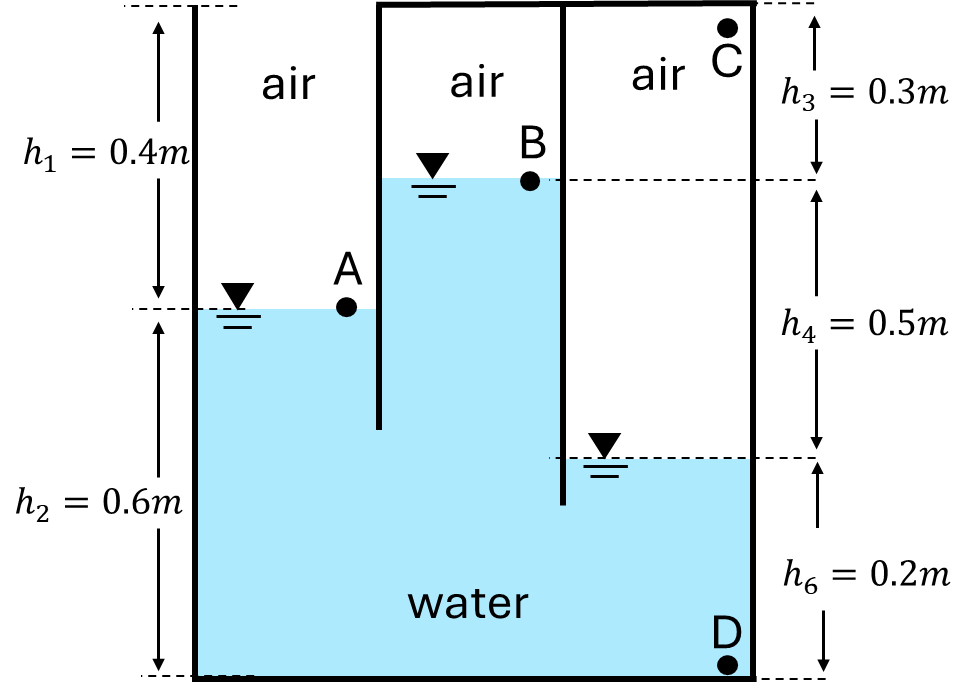
A connected vessel contains water and air at . The compartment on the left-hand side is opened to the atmosphere Pa.
Geometric data (see figure):
- Left bay: air space height above the left free surface m; water depth below that free surface m.
- Middle bay: the free surface (point ) lies m below the top;
- Right bay: distance from the bottom to the intermediate level is m.
- The water level difference between the central and the right bay is m
Determine the pressure at points B, C and D.
Data: ; .
Formulas you may need
- Pressure at depth: (on the formula sheet)
- Same pressure at the same level in one continuous static fluid (learn this)
- Pressure in a small trapped gas volume is uniform ( negligible) (learn this)