ENGR5003 Lecture 3 Example 2 (slide 22)
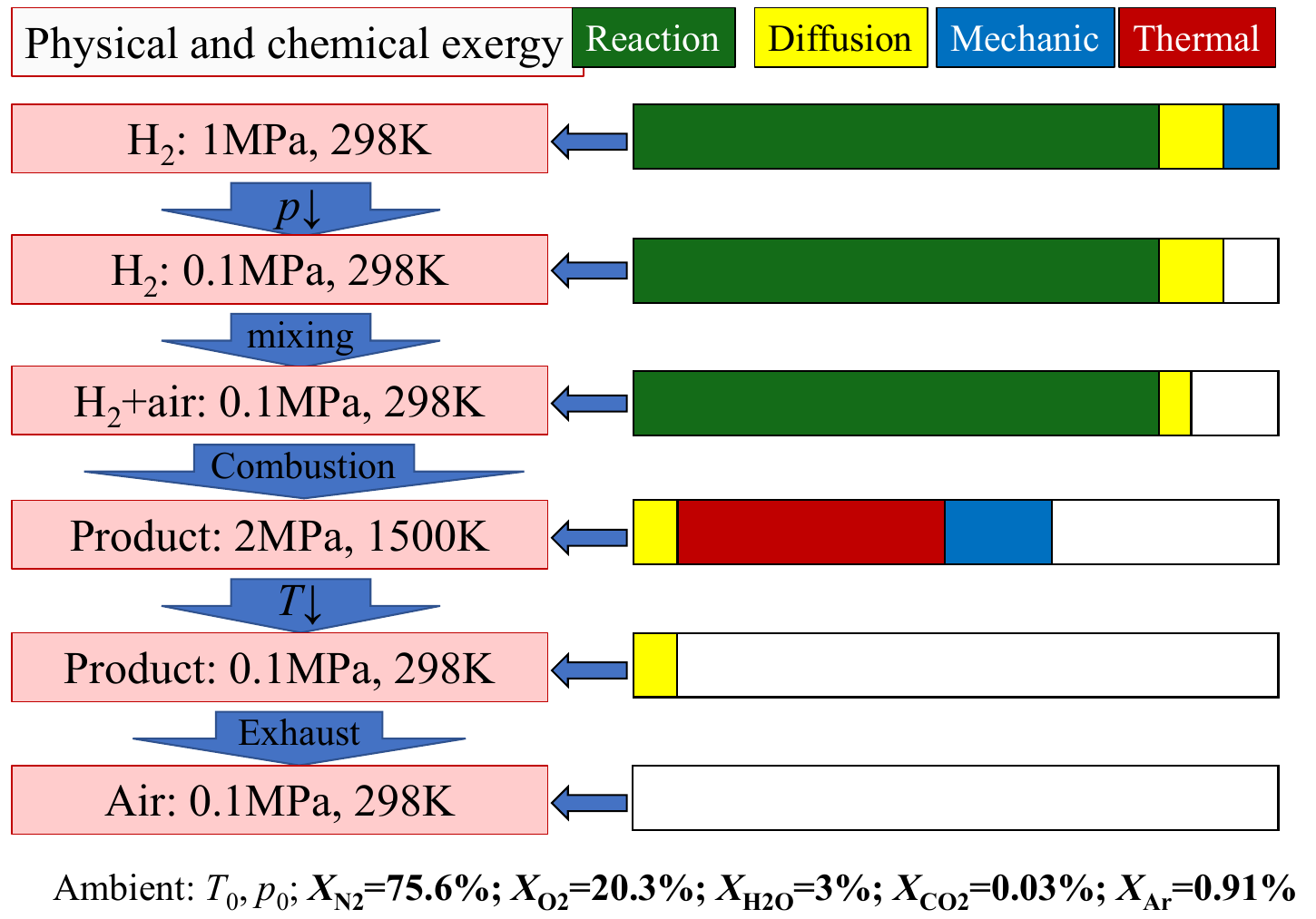
Figure 1 follows hydrogen from storage to exhaust: at 1 MPa, 298 K is throttled to 0.1 MPa, mixed with air, burnt (products at 2 MPa, 1500 K), cooled to 0.1 MPa, 298 K and finally exhausted to the atmosphere (ambient , ; mole fractions 75.6%, 20.3%, 3%, 0.03%, Ar 0.91%). Each bar shows the exergy of the stream split into reaction (chemical), diffusion (concentration), mechanical (pressure) and thermal parts; the white part of a bar is exergy that has been lost.
Formulas you may need
- Exergy: the maximum useful work obtainable as a system comes into equilibrium with its surroundings (learn this, Lecture 3)
- Exergy destroyed , with for any real process (learn this; is on the formula sheet)
- (a)For each step (pressure drop, mixing, combustion, cooling, exhaust), state which kind of exergy is lost and why.
- (b)Which step destroys the most exergy, and why does the stream still have exergy after cooling to 0.1 MPa and 298 K?
- (c)Suggest how the losses in the first three steps could be avoided or reduced.