ENGR201 Engineering Analysis 2018 B3[VALID]
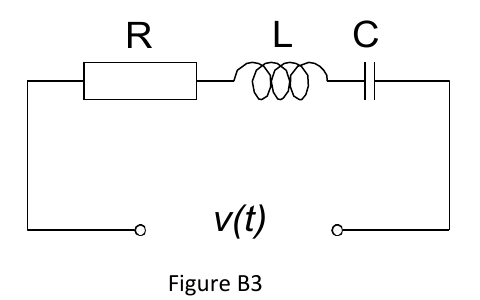
The quartz crystal is a small electronic component used in timing applications and sensing. It comprises a thin piece of quartz, sandwiched between two vapour-deposited electrodes, which oscillates in response to an r.f. excitation. The electrical characteristics of the crystal can be represented by the equivalent circuit in Figure B3: a resistor , inductor and capacitor in series, driven by a voltage .
Formulas you may need
- Component laws , , ; Kirchhoff's voltage law (learn this)
- Laplace with zero initial conditions: , ; unit step (learn this)
- (learn this; printed in the ENGR201 Laplace table)
- Second order form , damped frequency (learn this)
- (a)[4]ThirdShow that the differential equation describing the rate of voltage change with time in terms of current for the quartz crystal is explaining the origin of each term in your answer.
- (b)[8]2:2Using Laplace transformation, derive an expression describing the current response in terms of the voltage stimulus , given that the crystal is initially quiescent.
- (c)[8]If the quartz crystal is subject to an impulse voltage stimulus in the form of a unit step function at , determine an expression for the current response .
- (d)[5]2:2Given that , mH and pF, determine the time at which the current reaches of its initial value following the impulse. Approximately how many cycles will the quartz oscillator have undergone at this time?