ENGR201 Engineering Analysis 2019 B3[VALID]
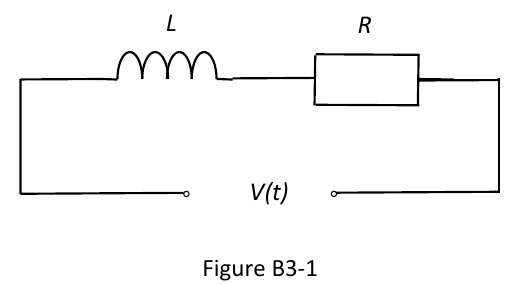
The circuit shown in Figure B3-1 consists of a resistor and an inductor connected in series with a voltage source .
Formulas you may need
- , , Kirchhoff's voltage law (learn this)
- (learn this; printed in the ENGR201 Laplace table)
- , , (learn this; printed in the ENGR201 Laplace table)
- Partial fractions with an irreducible quadratic: (learn this)
- (a)[7]ThirdWrite down a differential equation describing the rate of change of current with time, explaining the origin of each term in your answer.
- (b)[8]ThirdUsing Laplace transformation methods, derive an expression describing the current response in terms of the voltage stimulus , given that .
- (c)[10]If the voltage source is given by , derive an expression for the current response .