Figure A2-1 shows a typical RLC circuit. After applying Kirchhoff's law, the charge q(t) can be solved from
the differential equation
2dt2d2q(t)+16dtdq(t)+50q(t)=300(A1)
At t=0 the charge q(0) on the capacitor is zero and the current I(0)=dtdq(0) of the
circuit is also zero.
(Parts (c) and (d) of the original question, Newton iteration for the time of maximum current, are not on the
ENGR5001 syllabus and are left out.)
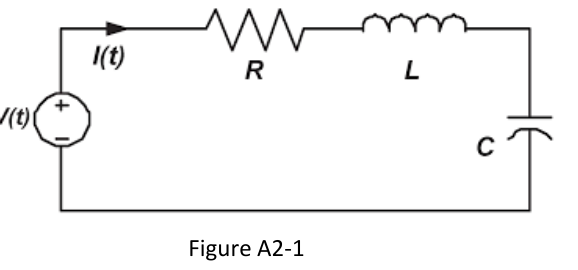 Figure A2-1: series RLC circuit driven by a voltage source V(t), current I(t).
Formulas you may need
- L[q′]=sQ−q(0), L[q′′]=s2Q−sq(0)−q′(0); constant c→c/s (learn this; printed in the ENGR201 Laplace table)
- eatcosωt↔(s−a)2+ω2s−a, eatsinωt↔(s−a)2+ω2ω (learn this; printed in the ENGR201 Laplace table)
- Current I=dtdq, so I(s)=sQ(s)−q(0) (learn this)
- (a)
Use the Laplace transform to find the charge
Q(s) in the s-domain.
- (b)
Use the inverse Laplace transform to find the charge
q(t) and the current
I(t) in the time domain.