ENGR202 Summer 2018 Q A1[VALID] official answers
Answer ALL parts (a) - (e).
Formulas you may need
- Newton's second law ; spring force ; viscous damper force (learn this)
- Generalised second order form (given in the question)
- Mass-spring-damper: , , steady state gain (learn this)
- Critical damping (learn this)
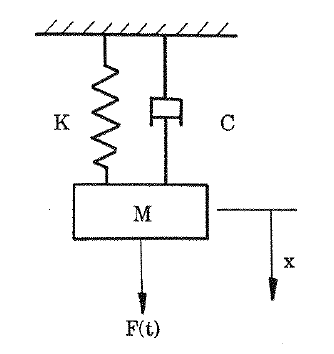
- (a)[3]For the mass-spring-damper system shown in Figure A1, derive a linear time invariant mathematical model expressing the displacement x as a function of the mass M, spring stiffness K and damping parameter C, when an external force F(t) is applied to the mass. List the assumptions you have made.
- (b)[5]Put the mass-spring-damper model into the standard second order form shown below. Find the steady state gain, damping ratio, natural frequency and forcing function.
- (c)[5]Sketch the response of the mass-spring-damper system for the case that and explain the significance of this result. On the same plot, sketch the response of a critically damped system. For the case that , determine the value of C that yields a critically damped system.
- (d)[6]The following differential equation represents the closed-loop dynamics of a proportional-velocity (PV) control system: where is the output and is the set point, while and are control gains. Design a controller (i.e. determine the values of the control gains) that yields closed-loop damping and rads/s. Find the steady state gain of the closed-loop system, and state whether or not this control system achieves steady state tracking of the set point.
- (e)[6]With the aid of sketches and/or any of the equations and analysis considered above, discuss the strengths and weaknesses of PV control in comparison to proportional-integral (PI) control.