ENGR202 Summer 2018 Q A2[VALID] official answers
Answer ALL parts (a) - (d).
Formulas you may need
- Laplace with zero initial conditions: (learn this)
- Stable if all poles have negative real parts; a single pole at the origin is marginally stable; repeated poles on the imaginary axis are unstable (learn this)
- Necessary conditions: all coefficients exist and have the same sign (learn this)
- Steady state gain (learn this)
- Unity feedback: (learn this)
- (a(i))[3]Consider one of the joints of a robotic manipulator, for which the joint angle and an applied voltage represent the output and input respectively. Define the terms open-loop and closed-loop control, using the robotic manipulator as an example.
- (a(ii))[3]Briefly explain the term stability. What are the likely practical consequences of using an unstable robotic manipulator control system?
- (a(iii))[2]Using the robotic manipulator as an example, explain the term dead-zone nonlinearity.
- (b)[6]A simplified model for the robotic manipulator (without control) is as follows: where is the joint angle and is the input. Determine the Transfer Function form of this model. Find the pole, plot its position on the complex plane and state the stability condition. Write down an expression for how to determine the steady state gain of this model, and comment on the physical interpretation of your answer.
- (c)[3]State the stability condition of the following characteristic equations, giving the reason for your answer in each case.
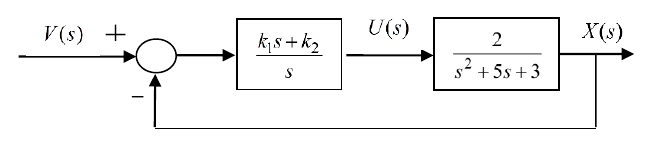
- (d(i))[1]Figure A2 shows a Proportional-Integral (PI) control system. Is the proportional gain or ?
- (d(ii))[4]Using algebra or the rules of block diagram manipulation, show that the Closed Loop Transfer Function is
- (d(iii))[3]Find the steady state gain of the Closed Loop Transfer Function and comment on the significance of your answer.