ENGR202 Summer 2019 Q B3[VALID] official answers
Generalised first order model:
Generalised second order model:
Formulas you may need
- Generalised first order model ; second order (given in the question)
- Tank: (conservation of volume) (learn this)
- Inductor ; capacitor ; Kirchhoff's voltage law (learn this)
- Steady state: (first order); times the input (second order) (learn this)
- (a)[5]In the generalised first order model, what are the names of the variables and ? For the first order model with and a steady input of 2 units, determine the value of . For the second order model, sketch the time response mode if and explain the physical significance of this result.
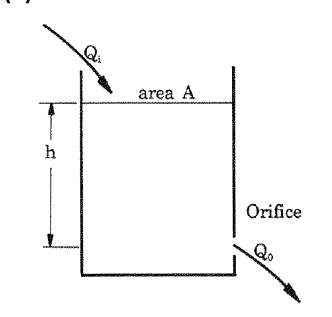
- (b)[5]For the tank system shown in Figure B3-1, derive an ordinary differential equation expressing the outflow rate , as a function of the inflow rate and area . You may assume that is proportional to the head of water . List any other assumptions you have made to develop this model. Convert the model into the generalised first order form. Determine the steady state gain and comment on the physical significance of this result.
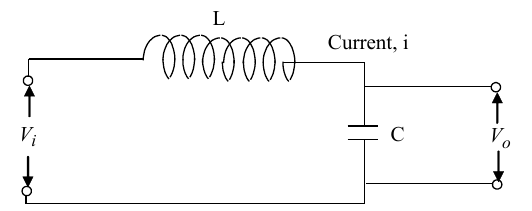
- (c)[7]For the LC circuit shown in Figure B3-2, derive a model expressing the voltage in terms of , and the applied voltage . List the assumptions you have made. Convert the model into a generalised second order form. Determine the forcing function, output, damping ratio and natural frequency of the model.
- (d)[8]Using the LC circuit as an example, explain what is meant by the following terms: (i) linear system; (ii) mechanistic model; (iii) open-loop system. Briefly explain how generalised model forms can be useful when analysing dynamic systems.