ENGR216 Summer 2024 Dynamics Q A1[VALID]
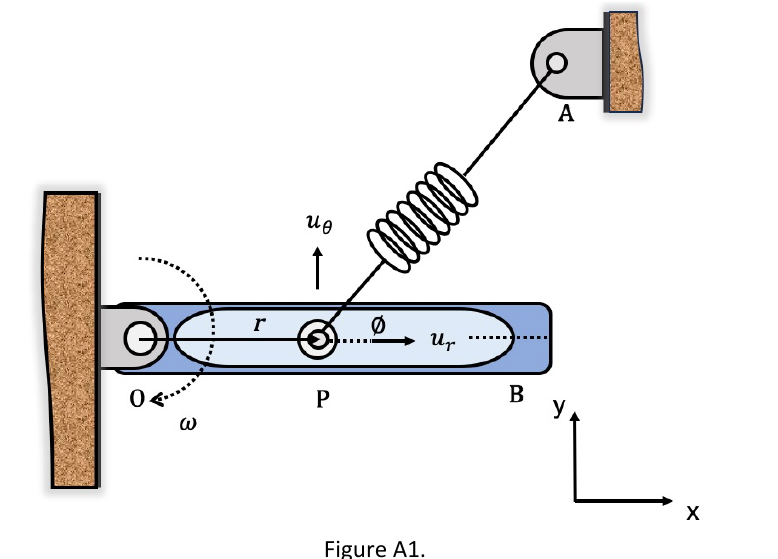
The smooth particle moves in the slot of a rotating arm and is attached to a spring extending from the fixed point to . The mass of is . The spring's stiffness is . The unstretched length of the spring is . The radial position and radial velocity of are and , respectively. At the instant shown in Figure A1: the angle is known, and the length of the spring is . The arm is rotating with a constant angular speed (clockwise) to the horizontal position. and represent the unit vectors of radial and transverse directions, respectively.
Note: , kg, N/m, m, rad/s.
Formulas you may need
- Polar velocity (learn this)
- Polar acceleration (learn this)
- Newton's second law in polar components , (learn this)
- Linear spring force , directed along the spring (learn this)
- (a)[10]2:2Draw the free body diagram and the kinetic diagram of .
- (b)[5]Determine the acceleration of the particle by using the variables: , , , , , and .
- (c)[5]2:2Given that the velocity of is m/s at the instant, calculate the numerical value for the normal force.
- (d)[5]Under the conditions in (c), is the particle pressing against the lower part of the slot or the upper part? Give your reasoning.