Dynamics Session 4 Worked example 2TutorialCurrent spec2:118 min

ENGR5004 Dynamics Session 4 worked example 2 (slides 14-16) official answers

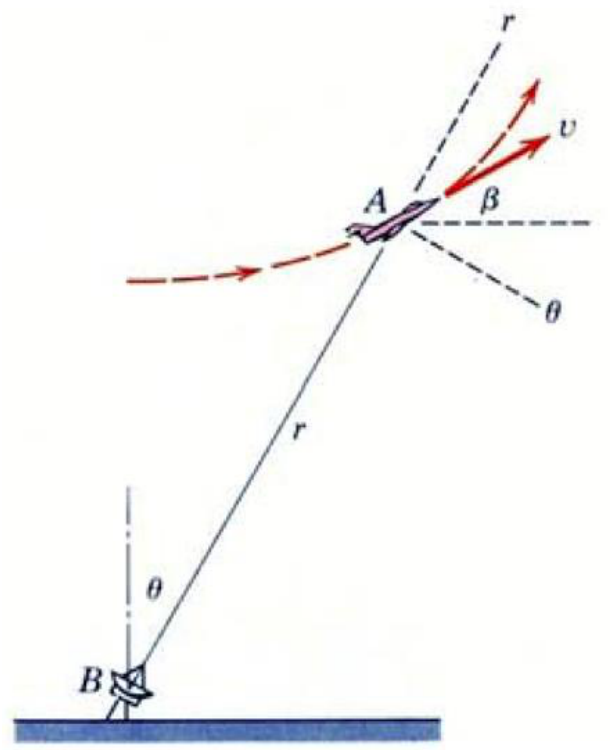
A plane is flying along a vertical loop of radius 600 m at a constant speed of 400 km/h. When the plane is at point A, its velocity is directed at β=30∘\beta = 30^\circ above the horizontal and the plane is entering the loop (the centre of the loop is above and behind the plane, on the concave side of its path).

A radar at B on the ground tracks the plane. At this instant it gives the plane's position as r=800r = 800 m and θ=30∘\theta = 30^\circ, where θ\theta is measured from the vertical through B towards the side the plane is flying to (so ur\mathbf u_r points 60∘60^\circ above the horizontal and uθ\mathbf u_\theta points 30∘30^\circ below the horizontal, see the figure).

Find the radial and transverse velocity components, and θ˙\dot\theta and θ¨\ddot\theta for this instant.

Radar at B tracks a plane at A: r = 800 m along a line at theta = 30 degrees from the vertical; the plane's velocity v is at beta = 30 degrees above the horizontal; the theta direction at A points down and to the right.
Formulas you may need
  • Polar velocity: vr=r˙v_r = \dot r, vθ=rθ˙v_\theta = r\dot\theta (learn this)
  • Polar acceleration: ar=r¨−rθ˙2a_r = \ddot r - r\dot\theta^2, aθ=rθ¨+2r˙θ˙a_\theta = r\ddot\theta + 2\dot r\dot\theta (learn this)
  • n-t components: at=v˙a_t = \dot v, an=v2/ρa_n = v^2/\rho (learn this)