ENGR202 (old spec) Control 2.4 Time Response, exercise
A vehicle of mass has displacement from a reference point, so its speed is . The engine imparts a force , friction is proportional to velocity (force ) and the rotational inertia of the wheels is negligible.
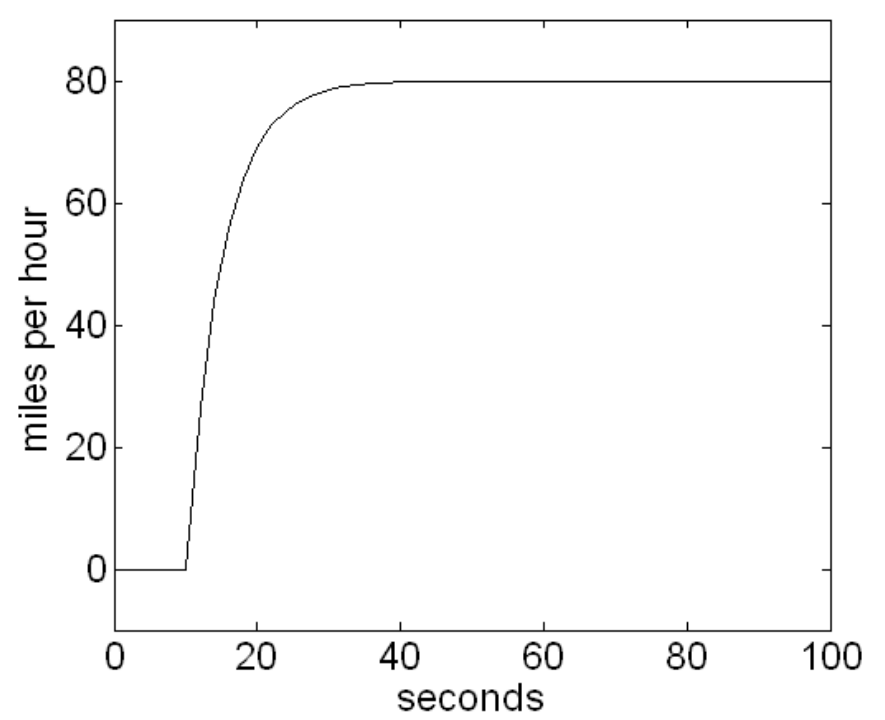
In an experiment, the engine force is stepped from 0% (zero force) to 100% (full power) at s. The resulting vehicle speed, in miles per hour, is shown in the figure.
Formulas you may need
- Newton's second law; friction force proportional to velocity (learn this)
- Generalised first order form (learn this)
- ; at the output has completed 63% of its change (learn this)
- (a)Develop a linear first order mechanistic model for the vehicle speed and express it in generalised first order form.
- (b)Estimate the steady state gain and time constant of the model from the graph, and hence write down the estimated model.