ENGR5001 Part 1 Self-Assessment Questions, Q2
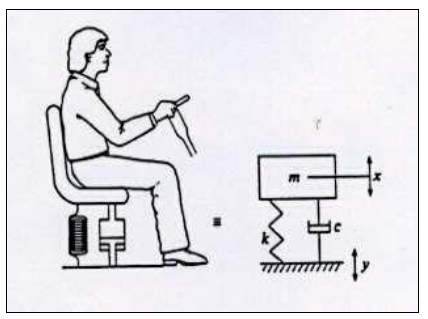
For a person sitting on the suspension seat below, develop a linear time invariant mathematical model showing the relationship between the floor movement and the seat position . (The seat and person are modelled as a mass supported on the floor by a spring and damper in parallel; and are vertical displacements.)
What assumptions have you made? Put the equation obtained into the standard form, indicating the steady state gain, damping ratio, natural frequency, forcing function and/or time constant.
Formulas you may need
- Newton's second law ; spring force (extension); viscous damper force (relative velocity) (learn this)
- Generalised second order form (learn this)
- Mass-spring-damper: , (learn this)