Dynamics L9 Worked example 1TutorialOld spec ENGR2162:118 min

ENGR216 Dynamics L9 worked example 1 (slides 10-12) official answers

A ball P of mass 0.5 kg rests on the smooth curved surface of a semicircular block (vertical plane, radius rc=0.4r_c = 0.4 m). It is pushed along the surface by a smooth arm OA that rotates anticlockwise about the point O at the left-hand end of the block's flat base (O lies on the circle). The arm angle θ\theta is measured from the horizontal base, so the ball's distance from O is r=2rccos⁡θr = 2r_c\cos\theta. At the instant θ=30∘\theta = 30^\circ, θ˙=0.4\dot\theta = 0.4 rad/s and θ¨=0.8\ddot\theta = 0.8 rad/s2^2. Take g=9.81g = 9.81 m/s2^2.

Find the force of the arm OA on the ball (and the normal force of the curved surface) at this instant.
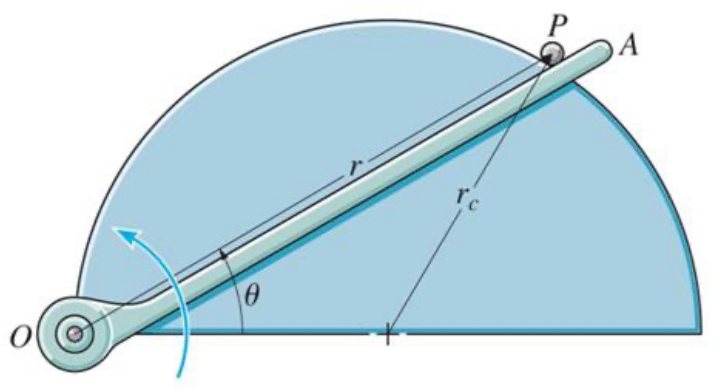
Semicircular block of radius r_c; arm OA pivoted at O (left end of the base) at angle theta; ball P sits on the curved surface against the arm, at distance r from O.
Formulas you may need
  • Polar acceleration: ar=r¨−rθ˙2a_r = \ddot r - r\dot\theta^2, aθ=rθ¨+2r˙θ˙a_\theta = r\ddot\theta + 2\dot r\dot\theta (learn this)
  • Equations of motion: ∑Fr=mar\sum F_r = m a_r, ∑Fθ=maθ\sum F_\theta = m a_\theta (learn this)
  • Chain rule for r=f(θ)r = f(\theta): r˙=f′(θ)θ˙\dot r = f'(\theta)\dot\theta, r¨=f′′(θ)θ˙2+f′(θ)θ¨\ddot r = f''(\theta)\dot\theta^2 + f'(\theta)\ddot\theta (learn this)