ENGR5004 Statics session 2 worked example 1 (Problem 1, slides 7-9) official answers
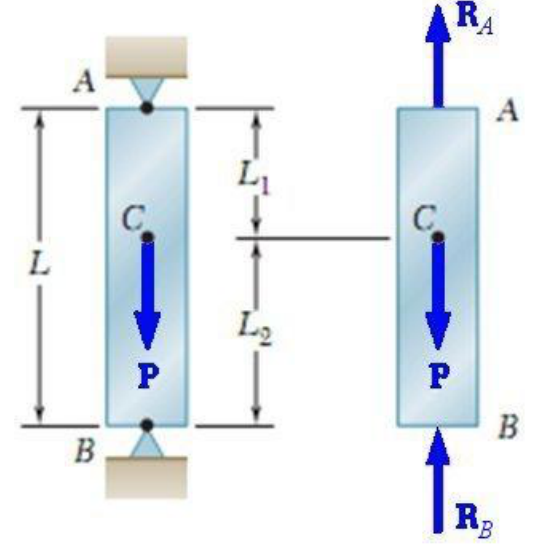
Bar AB of length and uniform cross section is attached to rigid supports at A (top) and B (bottom) before being loaded. A downward axial load is then applied at point C, a distance below A and above B (). The bar is linear elastic with Young's modulus .
Formulas you may need
- Equilibrium of the bar: (learn this)
- Axial deformation of a uniform segment , summed over segments (learn this)
- Compatibility for a bar between rigid supports: total change in length (learn this)
- Normal stress (learn this)
- (a)Draw the free-body diagram of the bar and explain why the reactions cannot be found from equilibrium alone.
- (b)Find the reactions and in terms of , , and .
- (c)Find the normal stresses in portions AC and BC, stating whether each is tensile or compressive.