ENGR216 Summer 2022 Statics Q A2[VALID] official answers
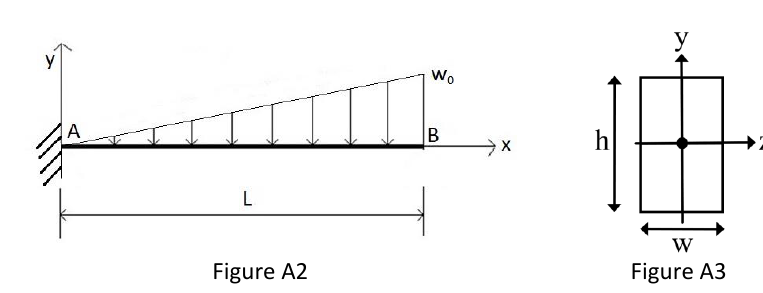
Consider the statically determinate system given by the cantilevered beam with flexural rigidity and length in Figure A2, subjected to a triangular distributed normal load varying from 0 at end A to at end B. The abscissa is the coordinate along the horizontal axis depicted in the figure with origin at end A of the beam.
Formulas you may need
- Equilibrium of a rigid body: , , (learn this)
- Resultant of a distributed load and its position (triangle: at from the zero end) (on the formula sheet)
- Load, shear and moment: , (on the formula sheet)
- Elastic curve , so ; clamped end: , (learn this; on the 2025 sheet but not the 2026 one)
- Rectangle bending about the axis parallel to the width : (on the formula sheet)
- Statically indeterminate beams by compatibility/superposition; cantilever with end load : (learn this)
- (a)[6]For the system in Figure A2, sketch the deformed shape of the beam longitudinal axis as accurately as possible, accounting for the action of the constraint at the end A.
- (b)[6]ThirdSketch the free body diagram of the loaded beam in Figure A2, clearly indicating all reactions and loads.
- (c)[4]ThirdKnowing that the equation of the deformed longitudinal axis of the beam is determine the magnitude of the bending moment at the fixed support as a function of and .
- (d)[4]The value of the maximum allowable vertical displacement of the beam free end is 1 mm, and the beam has a rectangular cross section of width and height , as shown in Figure A3. Determine the minimum value of to fulfill the aforementioned rigidity constraint. Use kN/m, mm, m and GPa.
- (e)[5]2:1State one constraint which could be applied to the end B to make the beam statically indeterminate, and, for the system thus obtained, list all nonzero reactions acting on the beam.