ENGR5004 Statics session 2 worked example 2 (Problem 2, slides 11-13 and Appendix 1 slide 16) official answers
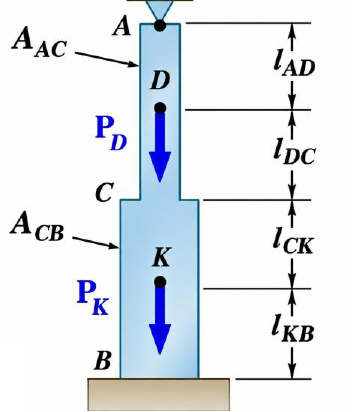
A vertical steel bar ( GPa) is fixed to rigid supports at A (top) and B (bottom), with a close fit at both supports before the loads are applied. Going down from A the bar passes points D, C and K: m. Portion AC has area and portion CB has area . Downward loads kN at D and kN at K are applied.
Determine the reactions at A and B using the superposition method, treating the reaction at B as redundant.
Formulas you may need
- Axial deformation of a stepped bar (learn this)
- Superposition: release the redundant support, find the deformation due to the loads and due to the redundant reaction , impose (learn this)
- Equilibrium (learn this)
- (a)With support B removed, find the elongation of the bar due to and .
- (b)Find the elongation due to an upward force alone at B (as a multiple of ), and hence and .