ENGR216 Summer 2022 Dynamics Q A1[VALID]
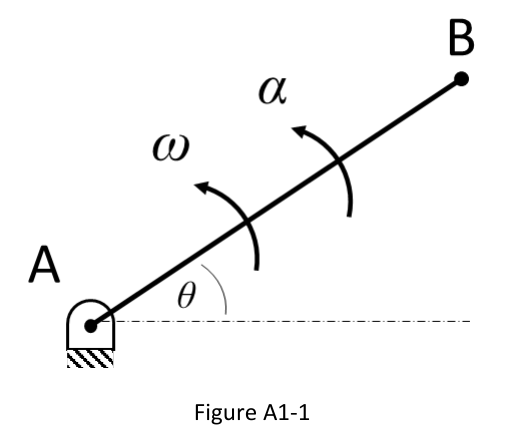
Figure A1-1 shows a single link, AB, rotating anticlockwise about a fixed pivot at A.
Formulas you may need
- Fixed-axis rotation, vector form: , (learn this)
- Polar coordinates: , ; Coriolis term (learn this)
- Normal-tangential: , , toward the centre of curvature (learn this)
- Constraint differentiation: , , , chain rule (learn this)
- (a)[6]2:2Figure A1-1 shows a link connected to fixed pivot at A and having angular acceleration and instantaneous angular velocity . Define and show on a sketch the velocity and acceleration components of point B when described in i. Cartesian coordinate system components. ii. Polar coordinate system components. iii. Normal-tangential coordinate system components.
- (b)[2]ThirdWhich coordinate system would you choose for an in-plane kinematic analysis of Figure A1-1, and why?
- (c)[3]2:2For the configuration shown in A1-1, would point B experience a Coriolis acceleration? Give your reasoning.
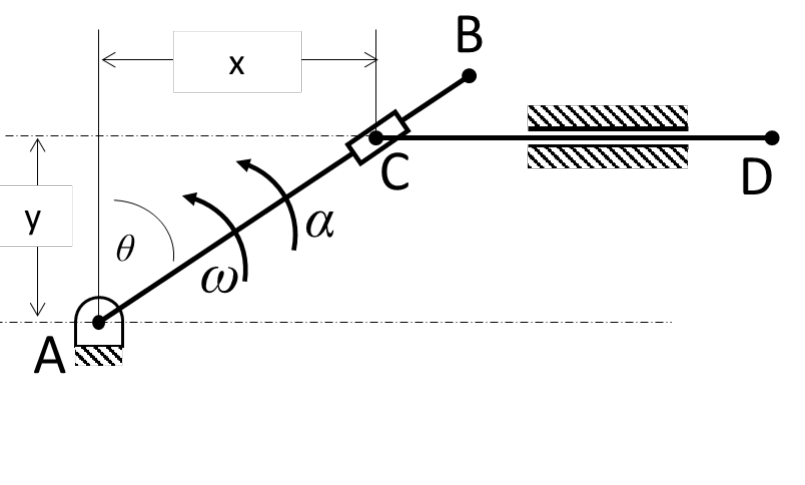
- (d)[6]Figure A1-2 shows an actuator mechanism. Link CD moves in a horizontal slide and the end C carries a block which slides along AB. Show that the linear velocity of CD is and also that the linear acceleration of CD is
- (e)[4]2:2Calculate the linear acceleration of CD when , m, rad/s clockwise and clockwise.
- (f)[4]2:2If CD moves with constant linear velocity, and the angular velocity of AB is 1 rad/s clockwise, find the angular acceleration of AB when and m.