ENGR216 Summer 2025 Q B2[VALID] official answers
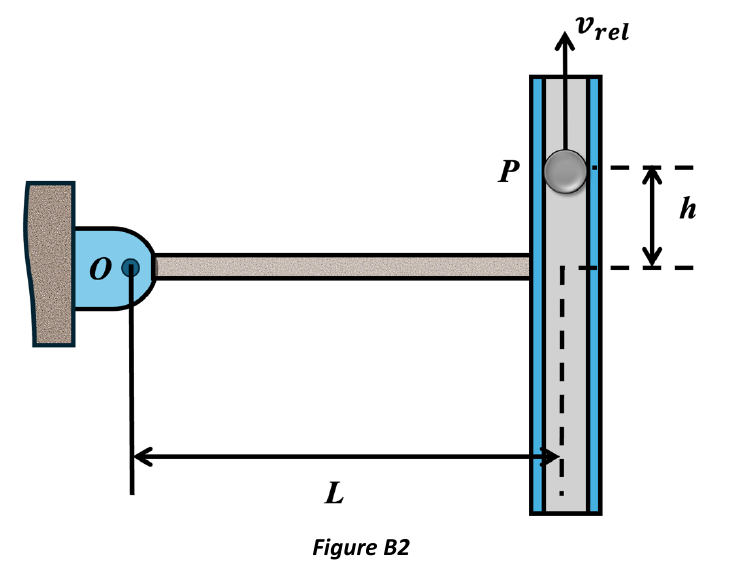
A particle (P) of mass () slides in a tube with the relative velocity of . The tube and the rod (perpendicular to the tube) rotate counterclockwise about point O with angular velocity and angular acceleration . At the instant shown in Figure B2, the horizontal and vertical distance between O and P is and , respectively. and are the kinetic and static friction coefficients between P and the tube.
Formulas you may need
- Rotating-axes acceleration: (given in the question)
- Unit-vector cross products: , (learn this)
- Newton's second law for a particle: , in components (learn this)
- Kinetic friction , opposing the relative sliding; static only when there is no sliding (learn this)
- (a)[10]Draw the free-body and kinetic diagrams of the particle P. State appropriate coordinate systems.
- (b)[10]Determine the acceleration of the particle P. Hint: use the following equation:
- (c)[5]2:2Determine the normal force and friction force of the particle P.