ENGR216 Dynamics L8 worked example 3 (slides 14-15) official answers
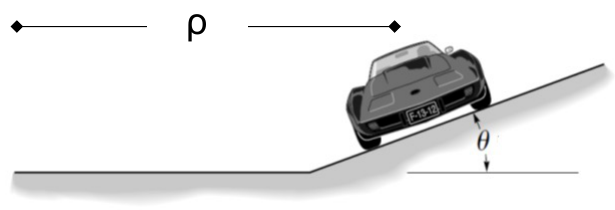
A car of mass 1700 kg travels on a circular track of radius of curvature 100 m that is banked at (the track rises away from the centre of curvature). The coefficient of static friction between tyres and road is . Treating the car as a particle, find the maximum constant speed at which it can travel without slipping up the slope. Take m/s.
Formulas you may need
- n-t equations of motion: , (learn this)
- Friction at impending slip: , opposing the impending motion (learn this)